 Sumas Roofing
 The Shingles Are Just the Cover Page
When most homeowners think about their roof, they picture the shingles — the color, the style, maybe the brand. That's fair; it's the part you can see from the driveway. But the shingles are really just the outer skin. Everything that actually keeps water, wind, and moisture out of your attic and walls lives underneath them: the decking, the underlayment, the flashing, and the ventilation system working together. A roof with premium shingles over a weak deck or missing underlayment will fail long before a roof with modest shingles installed correctly over a solid, well-protected base.
This matters more here than in a lot of places. Whatcom County sees long stretches of driving rain, marine-influenced weather rolling in off the coast, and a moss season that can stretch for months. Sumas sits in that same weather pattern, tucked against the Nooksack River valley near the Canadian border, and roofs here take a steady beating from moisture rather than dramatic storms. It's the slow, patient kind of wear that gets missed until it's expensive.
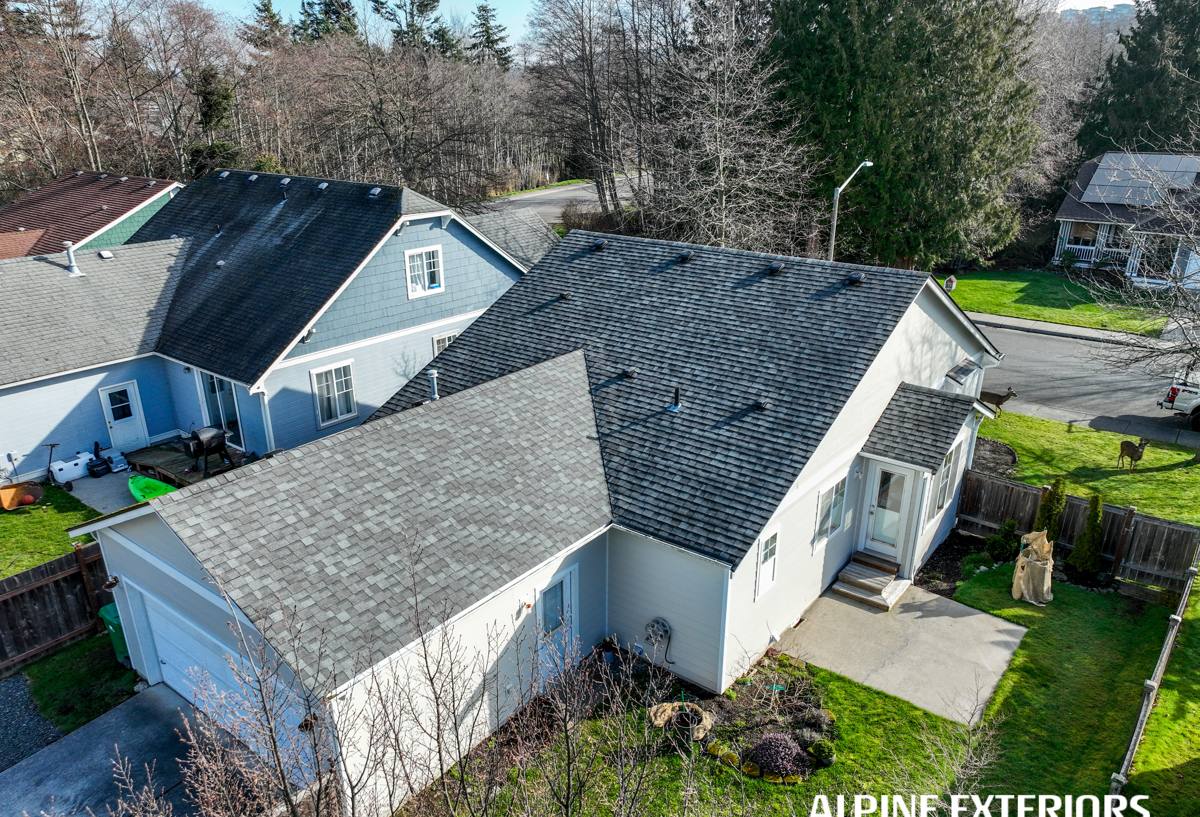
The Roof Deck: Everything Else Depends On It
The roof deck — usually plywood or OSB (oriented strand board) — is the structural platform everything else attaches to. It's easy to overlook because you never see it once the roof is finished, but it's also the layer most likely to hide problems for years.
What can go wrong under the surface
- Soft or delaminated spots from long-term moisture intrusion, often invisible from above until a roofer walks the deck
- Nail pops and fastener backout as wood swells and shrinks with seasonal moisture cycles
- Sagging between rafters from years of standing moisture or undersized decking
- Old decking that was never designed for today's heavier architectural shingles
A tear-off is really the only honest way to know what condition your deck is in. Any contractor who quotes a full reroof without ever planning to inspect the deck once shingles are stripped is guessing, not diagnosing.
Underlayment: The Layer Doing the Real Work
Underlayment is the water-resistive barrier installed directly over the deck, before shingles go down. If wind ever lifts a shingle, if ice backs up at the eaves, or if wind-driven rain gets pushed sideways under a shingle tab, the underlayment is what stands between that moisture and your living space. It's not a backup system — it's doing real work on every roof, every storm.
The main types you'll encounter
There are three general categories of underlayment used on residential roofs today, and each has real trade-offs rather than one being universally "better."
| Underlayment Type | Strengths | Trade-offs |
|---|---|---|
| Traditional felt (asphalt-saturated paper) | Low cost, long track record, easy to work with in mild weather | Heavier, tears more easily, absorbs moisture if exposed before shingles go on, shorter usable lifespan |
| Synthetic underlayment | Lighter, stronger, more tear-resistant, better footing during install, holds up longer if weather delays the job | Slightly higher material cost; performance varies by product grade |
| Peel-and-stick (self-adhering) membrane | Seals around nail penetrations, excellent protection at vulnerable spots | Higher cost, installation is less forgiving of temperature and surface prep, not typically used across a whole roof |
Most well-built roofs in this region use synthetic underlayment across the main field of the roof, with a self-adhering ice-and-water membrane reinforcing the most exposed areas — eaves, valleys, and roof penetrations — where the majority of leaks actually start.
Ice and Water Shield: Not Just for Ice
The name is a little misleading for our climate. This self-sealing membrane is code-required along eaves in many cold-climate areas because of ice damming, but in Whatcom County its real value is defending against wind-driven rain and the kind of slow water backup that happens during our long, saturating rain events. It's applied at eaves, in valleys where water volume concentrates, and around chimneys, skylights, and vent penetrations — the spots where flat shingle coverage alone isn't enough.
Flashing: Small Metal, Big Responsibility
Flashing is the metalwork — step flashing, valley flashing, counter-flashing, and drip edge — that seals transitions where the roof plane meets something else: a wall, a chimney, a skylight, another roof section. Shingles are designed to shed water in a straight, continuous pattern. Anywhere that pattern breaks, flashing has to take over.
Poorly installed or reused flashing is one of the most common causes of leaks we find during inspections, and it's rarely visible from the ground. Rusted, undersized, or improperly lapped flashing can look fine for years before it fails, which is why flashing condition should always be part of an honest roof evaluation — not an afterthought during a shingle-only quote.
Ventilation: The System Working Against Moss and Moisture From Below
A roof isn't just protecting against rain from above — it's also managing moisture and heat moving up from inside the house. Balanced ventilation, meaning enough intake at the eaves and exhaust at or near the ridge, keeps the attic close to outdoor temperature and lets moisture escape instead of condensing on the underside of the deck.
Why this matters so much here
Our long, damp shoulder seasons are exactly the conditions that grow moss, and moss holds moisture directly against the shingle surface longer than open air would. Poor attic ventilation compounds the problem two ways: it keeps the roof deck cooler and damper than it should be, and it can drive condensation that soaks insulation and framing from underneath, completely separate from anything happening on the shingle surface. A roof can have perfect shingles and underlayment and still develop rot problems if the attic below it is trapping moisture.
How Sumas and Whatcom County Weather Changes the Math
Every region has a climate personality that roofs have to be built for. Ours isn't hurricanes or hail — it's persistence. Long stretches of driving rain, marine air moving in off the coast, and moss seasons that run far longer than a couple of weeks. None of that shows up as a single dramatic failure. It shows up as a slow accumulation: shingles that hold moisture a little longer each season, fasteners that work loose a little more each freeze-thaw cycle, decking that stays damp a little longer than it should after each storm.
That's exactly why the layers under the shingles matter more here than in drier climates. A roof built with adequate underlayment, correctly lapped flashing, and real attic ventilation will shrug off another wet Whatcom County winter. A roof that's cutting corners in those hidden layers will show it — just not right away, and usually not until repair costs are higher than they needed to be.
What to Ask Before You Sign a Roofing Contract
Because so much of a roof's real performance is invisible once it's finished, the questions you ask before the work starts matter as much as the shingle brand you pick.
- What underlayment product and coverage will be used, and where will ice-and-water membrane be installed?
- Will old flashing be reused, or replaced with new metal at valleys, walls, and penetrations?
- Is the roof deck being inspected once the old shingles are removed, and how are soft spots handled if found?
- What's the plan for intake and exhaust ventilation, not just the shingle-level exhaust vents?
- Does the written estimate spell out these layers, or does it only list the shingle product and color?
A contractor who can answer these clearly, without hesitation, is someone who's actually thinking about your roof as a system. A quote that only talks about shingle brand and color is a quote that hasn't addressed the parts of the job that determine whether the roof lasts fifteen years or thirty.
Signs It's Time to Look Beneath the Surface
You don't need to wait for a leak to justify a closer look. Some signs are worth acting on before water ever makes it inside:
- Persistent moss growth that keeps returning after cleaning
- Shingle edges that curl, lift, or look inconsistent in one section of the roof
- Visible sagging along a roof plane, even subtle
- Rusty streaking near flashing, chimneys, or valleys
- Attic humidity, musty smell, or visible condensation on the underside of the deck
- A roof approaching or past the midpoint of its expected lifespan with no known history of underlayment or ventilation work
Any one of these is worth a straightforward inspection rather than a wait-and-see approach. Catching a deck or ventilation issue early is a far smaller job than repairing the damage it eventually causes.
Getting a Straight Answer About What's Really There
The only way to really know what condition the layers under your shingles are in is to have someone experienced take a direct look — from the attic side and, when a reroof is being considered, from the deck side as well. If you're curious about your roof's condition, thinking ahead to a future reroof, or just want a plain-English rundown of what's underneath your current shingles, we're glad to come take a look. Reach out for a free, no-pressure estimate using the form below.