 Sumas Roofing
 Siding in Lynden and Sumas Faces a Specific Set of Problems
Homes around Lynden and Sumas sit in the Nooksack River valley, close enough to the Strait of Georgia and Puget Sound that marine air pushes inland on a regular basis. That air carries moisture and a light salt load, and it settles into a landscape that's already wet most of the year from driving rain off the foothills. Add a shaded, slow-drying north side or a fence line that blocks airflow, and you get the third piece: a moss and algae season that can run eight or nine months instead of a few weeks. None of this is exotic weather. It's just relentless, and siding here either handles that combination or it starts failing years before it should.
A siding installation that would hold up fine in a drier part of the state can struggle in Whatcom County. The difference isn't the product alone — it's whether the installer actually built the assembly to shed water, dry out between storms, and resist the organic growth that thrives in constant dampness. That's the standard we hold every Lynden and Sumas job to.
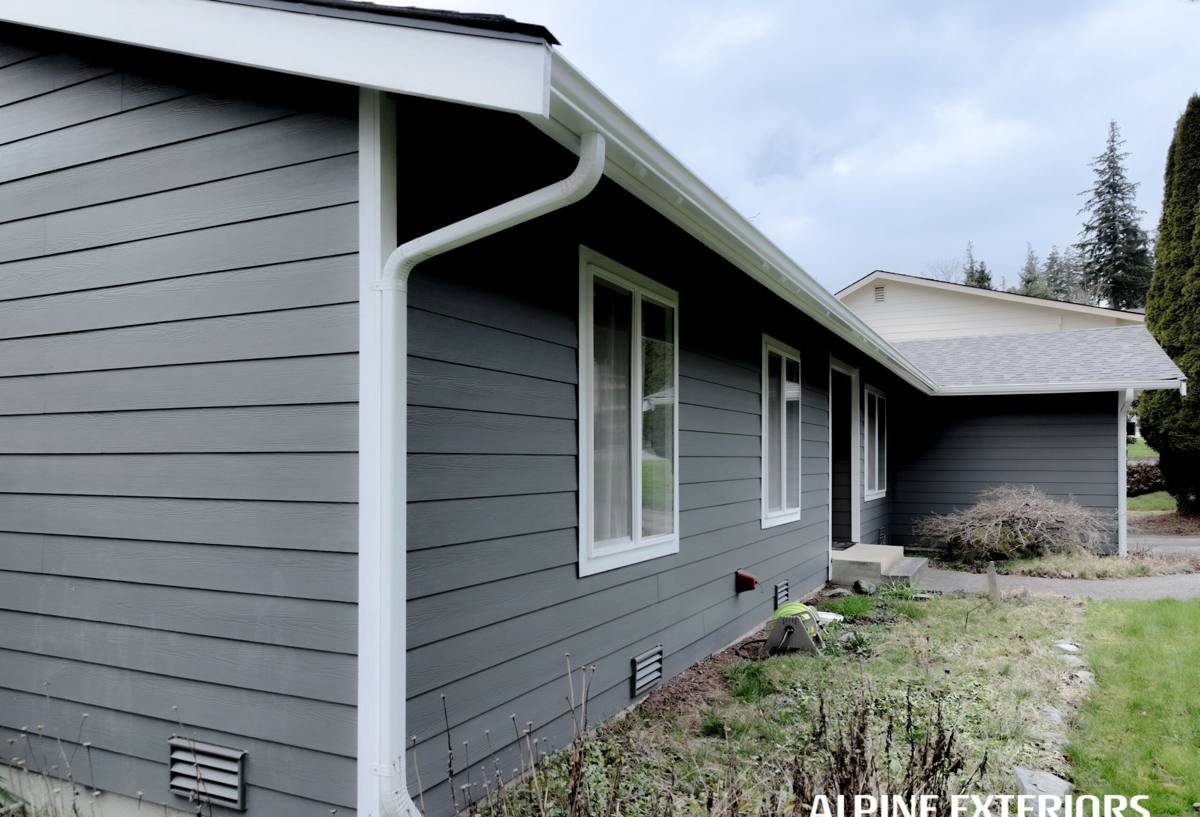
What Local Homes Actually Need From Their Siding
Moisture Management, Not Just a Weather-Resistant Face
The visible siding panel is the last line of defense, not the only one. Behind it needs to be a correctly lapped weather-resistant barrier, properly flashed windows and doors, and a drainage path for the water that inevitably gets behind the cladding during a hard, wind-driven rain. Skip any of those and the siding can look fine from the curb while the wall assembly underneath is staying wet.
A Material That Doesn't Feed Moss and Algae
Organic growth needs a surface it can hold onto and moisture it can feed on. Porous or fibrous siding surfaces give moss and algae exactly that. A dense, factory-finished surface gives it a lot less to work with, which matters on shaded elevations and tree-lined lots that are common around both towns.
Resistance to Repeated Wet-Dry Cycling
Whatcom County doesn't get one wet season and one dry season — it gets rain, a few dry days, more rain, on repeat for most of the year. Siding that swells when wet and shrinks when it dries eventually loosens fasteners, opens joints, and lets paint or finish fail early. A stable material holds its dimensions through that cycle instead of working itself loose over a decade.
Why We Install James Hardie Fiber Cement — and Nothing Else
We are a James Hardie-only siding contractor. We don't install vinyl, LP SmartSide, primed wood, cedar, or other fiber cement brands, and that's a deliberate standard, not a lack of options. In a climate like this one, the differences between products stop being cosmetic and start being about whether the wall stays dry and intact.
- Non-combustible core: fiber cement doesn't feed a fire the way wood-based or vinyl products can, which matters for insurance and for peace of mind.
- Factory-applied ColorPlus finish: the color and topcoat are baked on under controlled conditions, which holds up better against UV and moisture than most field-applied paint jobs, and it doesn't need repainting on the timeline that painted wood or fiber cement does.
- Engineered for this region: Hardie's HZ5 product line is formulated for climates with sustained moisture and freeze-thaw swings, which describes Whatcom County winters accurately.
- Dimensionally stable: it doesn't swell and shrink with every wet-dry cycle the way wood-based sidings can, so joints and fasteners stay tight longer.
- A real transferable warranty backed by decades of manufacturer track record, not a startup product line still proving itself in the field.
That's not a knock on every alternative product in isolation — some of them perform reasonably well in mild, dry climates. It's that we don't think it's honest to install something in a valley that gets this much sustained moisture and tell a homeowner it'll perform the same as it would in Spokane or Yakima. We'd rather install one product correctly than several products with an asterisk.
Our Installation Process for Lynden and Sumas Homes
- On-site assessment: we look at the existing siding, sheathing condition, window and door flashing, and any trouble spots — north-facing walls, low-airflow corners, areas with visible moss or staining.
- Tear-off and sheathing check: old siding comes off and we inspect what's underneath. Rot or moisture damage found at this stage gets repaired before anything new goes up — covering a problem is not an option.
- Weather-resistant barrier installed correctly lapped: water needs a clear downhill path behind the siding, and every lap and seam is installed to shed it that direction.
- Rainscreen gap where the wall assembly calls for it: a small air gap behind the siding lets bulk water drain and the wall dry out between storms instead of trapping moisture against the sheathing.
- Flashing at every penetration: windows, doors, hose bibs, light fixtures — every place water can find its way in gets proper flashing and sealant, not just caulk over a gap.
- James Hardie panels or lap siding installed to manufacturer spec: correct fastener type and placement, correct clearances, correct nailing pattern. Installation sensitivity is real with fiber cement — done wrong, it can crack or trap moisture at the joints. Done right, it lasts for decades.
- Trim, caulking, and final detailing: the small stuff — corner treatments, butt joints, touch-up paint at cut ends — is where a rushed job shows up first, so we don't rush it.
Quick Checklist: What Correct Siding Work Looks Like
- Sheathing inspected and any rot repaired before new siding goes up
- Weather-resistant barrier lapped correctly, shingle-style, top over bottom
- Rainscreen gap present where the assembly calls for it
- Every window, door, and penetration properly flashed
- Fasteners at manufacturer-specified spacing and depth — not overdriven
- Cut ends and exposed edges sealed or painted, not left raw
- Proper clearance kept between siding bottom edge and grade, decks, or roofing
What We Commonly See on Older Lynden and Sumas Homes
A lot of the siding replacement work in this area isn't cosmetic — it's structural moisture damage that's been building for years. The patterns repeat often enough that they're worth naming plainly:
| What We Find | Why It Happens Here |
|---|---|
| Moss and algae staining, especially north and shaded walls | Long wet season plus low airflow gives organic growth time and moisture to establish |
| Soft or delaminating siding near ground level | Splashback and poor grade clearance keep the lower courses wet longer than the rest of the wall |
| Cracked or gapped caulk joints at trim and windows | Repeated wet-dry cycling works old caulk loose faster than in drier climates |
| Paint failure and bare wood at cut ends | Unsealed field cuts on wood-based siding absorb moisture directly |
| Warping or buckling panels | Sustained moisture exposure on materials not engineered for this level of dampness |
What Affects the Cost of a Siding Installation
Every Lynden and Sumas home is different, and a real number only comes from seeing the house, but these are the factors that move the price most:
| Factor | How It Affects the Job |
|---|---|
| House size and wall complexity | More corners, gables, and cutouts mean more labor and material waste |
| Condition of the existing sheathing | Rot repair found during tear-off adds time and material before new siding can go up |
| Siding profile chosen | Lap siding, panel siding, and shingle-style Hardie products differ in material and labor cost |
| Trim and detail work | Corner boards, window trim, and accent details add labor beyond the flat wall area |
| Site access | Tight lots, fencing, or multi-story walls affect scaffolding and staging time |
Why Hiring a Crew That Already Works This Area Matters
Siding installation isn't just a manufacturer's instruction sheet applied the same way everywhere. A crew that works Lynden and Sumas regularly already knows which elevations on a given lot layout tend to hold moisture, where moss takes hold fastest, and how much clearance the local rain intensity actually calls for at grade and roof lines. That's not something you get from a spec sheet — it's from doing the work in this specific climate, house after house.
It also matters for accountability. A contractor who's based in the area and plans to keep working here has a real reason to get the flashing and rainscreen details right the first time, because a callback isn't a stranger 200 miles away — it's a neighbor.
Get a Straight Answer for Your Home
If your siding is showing moss buildup, soft spots, or paint failure, or you're just planning ahead for a replacement, we're glad to take a look and give you a straightforward assessment — no pressure, no inflated scope. Fill out the form below for a free estimate on siding installation for your Lynden or Sumas home.