 Sumas Roofing
 A Local Crew Just Across the Line
Abbotsford sits close enough to Sumas that "local contractor" isn't a marketing phrase for us — it's a short drive down the same stretch of road most of our Whatcom County customers use. We've built our business around this corner of the Pacific Northwest, where the border between Washington and British Columbia runs through farmland, foothills, and neighborhoods that share the exact same weather. A roof in Abbotsford fails for the same reasons a roof in Sumas fails. The moss doesn't stop at customs, and neither does the rain.
We take on work in Abbotsford because we already know what the climate does to homes here, and because we'd rather build a long-term relationship with a handful of nearby communities than spread ourselves thin across a region we don't actually know. When you call us, you're talking to people who have already seen what your neighborhood's roofs and siding look like after ten, twenty, or thirty wet seasons.
What Fraser Valley Weather Does to a Home
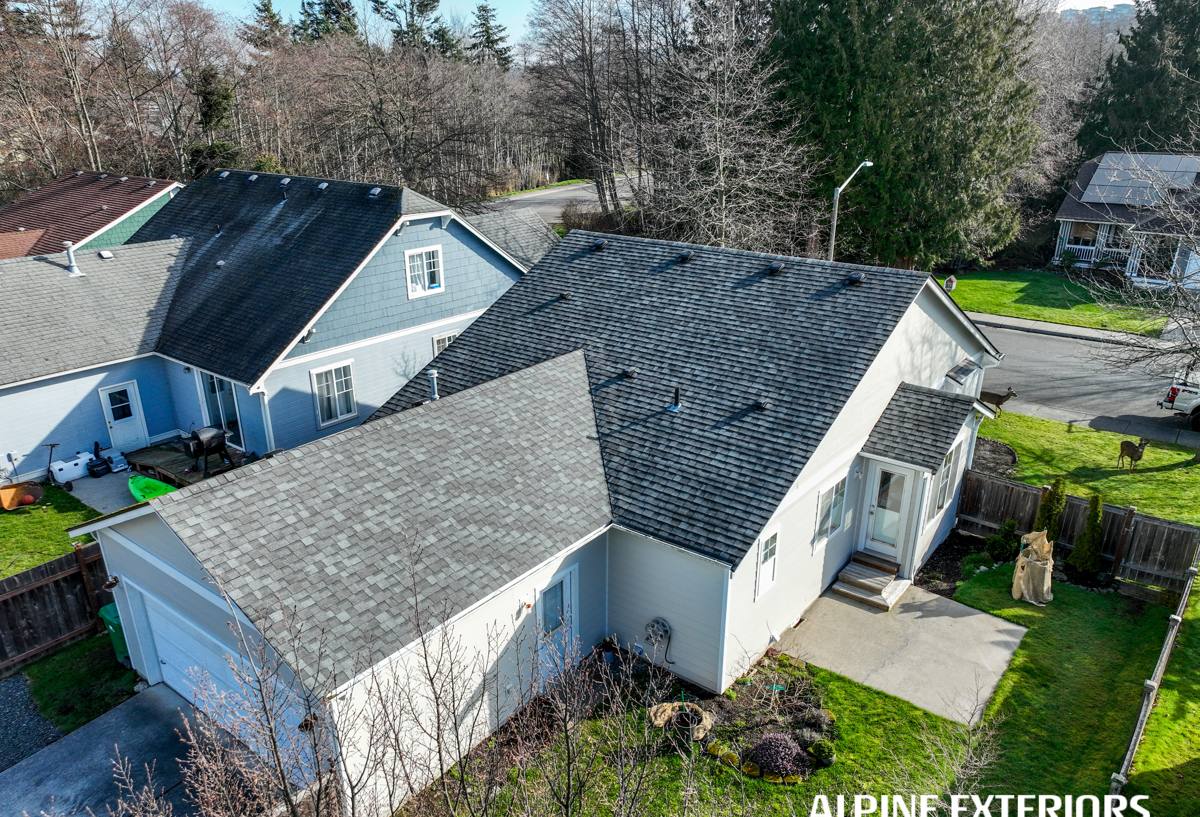
Abbotsford and the surrounding Fraser Valley sit in a pocket where marine air off the Pacific, salt-tinged in the wind that pushes inland, meets the foothills of the Cascades and Coast Mountains. That combination produces long stretches of driving rain — not the gentle vertical kind, but rain pushed sideways by wind, which finds every gap in flashing, siding laps, and window trim that vertical rain would never reach. It also produces the shade, humidity, and mild temperatures that moss and algae need to thrive for most of the year.
Moss and Algae
North-facing roof slopes, areas under overhanging trees, and anything that stays damp longer than it should are where we see the worst moss buildup. Left alone, moss doesn't just look bad — it lifts shingle edges, holds moisture against the roof deck, and accelerates granule loss on asphalt shingles. On siding, algae staining is mostly cosmetic, but it's a sign that a wall isn't drying out between rain events, which matters more than the staining itself.
Wind-Driven Rain
Horizontal rain is the reason so many water problems in this region show up around windows, at siding butt joints, and at roof-to-wall transitions rather than in the open field of a roof. Standard flashing and standard caulking are often not enough on a home that regularly takes rain sideways for hours at a time. It takes deliberate detailing — proper laps, correct flashing sequencing, and the right underlayment — to keep water out under those conditions.
Freeze-Thaw and Seasonal Swings
Winters here aren't extreme, but they're not stable either. Freezing nights followed by wet, above-freezing days put stress on any material that traps water — cracked caulk, failed flashing seals, and aging shingle edges all get worse through these cycles rather than better.
Roofing Services for Abbotsford Homes
Most of the roofing calls we get from this area fall into a few categories: moss and debris cleanup with an inspection behind it, targeted repairs after a windstorm or a leak shows up, and full replacements on roofs that have simply reached the end of their service life. We inspect before we recommend — a roof with isolated flashing failure doesn't need a full tear-off, and we'll tell you that plainly even if a replacement would be the bigger job for us.
Inspection and Repair
A proper inspection covers the field of the roof, all flashing points (chimneys, skylights, valleys, wall transitions), the condition of the underlayment where it's visible, and the state of gutters and downspouts, since clogged gutters are one of the most common causes of water backing up under shingle edges. Repairs are scoped to the actual problem — we don't upsell a full replacement to fix a localized leak.
Full Roof Replacement
When a roof is genuinely at the end of its life — widespread granule loss, brittle or cracking shingles, repeated leaks in different spots — replacement is the honest recommendation. We'll walk you through material options, ventilation (which matters enormously for moss resistance and shingle lifespan in this climate), and a realistic timeline that accounts for weather windows, since roofing in the wet season requires more planning than roofing in July.
Siding That Holds Up to the Valley's Wet Cycles
Siding in this climate has one main job beyond looking good: managing water that hits it sideways and keeps the wall assembly behind it dry. We install and repair fiber cement, engineered wood, and vinyl siding, and we pay close attention to the details that matter most here — proper flashing above windows and doors, correct overlap at horizontal laps, and rainscreen or drainage-gap approaches where they make sense for the wall assembly. Any siding product will fail early if it's installed without those details, regardless of what the manufacturer's brochure promises.
Why We're Selective About Products
We don't install every siding product on the market. Some materials that perform well in drier climates are more sensitive to installation error, more prone to moisture-related warranty claims, or simply harder to seal correctly against wind-driven rain. Our standard is to install products we can stand behind for the specific way water behaves against a wall in the Fraser Valley — not the cheapest option, and not necessarily the most fashionable one, but the one that will still be doing its job in fifteen years.
Windows: Sealing Out Wind-Driven Rain
Window failures in this region are usually not about the glass — they're about the flashing, the sealant, and the sill pan underneath the window unit. A window that's been improperly flashed will eventually let water track down into the wall cavity, and by the time you see staining or soft trim inside, that damage has usually been building for a while. When we replace or install windows, flashing and sill detailing get the same attention as the window unit itself. We also look at how existing windows are performing when we're on a roof or siding job nearby, since it's often more efficient to address a window issue before it turns into a bigger repair.
Decks Built for a Damp Climate
Decks take a beating from this climate in a different way — standing water, slow drying between rain events, and UV exposure that cracks and grays wood faster than homeowners expect. We build and repair decks with attention to proper drainage (correct board spacing and slope away from the house), ledger board flashing where the deck meets the structure, and fastener choices that won't corrode or stain the wood over time. Composite decking is a common request because it sidesteps a lot of the maintenance burden of wood in a wet climate, but we'll talk through the real trade-offs — cost, appearance, and repairability — rather than just pushing whichever material has the better margin.
Comparing Common Roofing Materials in This Climate
| Material | Typical Lifespan | Moss/Algae Resistance | Notes for This Climate |
|---|---|---|---|
| Asphalt shingle (standard) | 20-25 years | Moderate; benefits from algae-resistant granules | Most common choice; performance depends heavily on ventilation and installation quality |
| Asphalt shingle (impact/algae-resistant) | 25-30 years | Better | Worth the upgrade cost on shaded, north-facing, or tree-covered roofs |
| Metal roofing | 40-plus years | Good; sheds moss more easily due to slick surface | Higher upfront cost, sheds snow and rain fast, low maintenance |
| Cedar shake | 20-30 years with upkeep | Poor without regular treatment | Requires ongoing maintenance in a wet, mossy climate; we're honest about that burden upfront |
A Homeowner's Maintenance Checklist
- Clear gutters and downspouts at least twice a year, more often if you have overhanging trees
- Have moss physically removed rather than just chemically treated, especially on north-facing slopes
- Check attic ventilation — poor airflow speeds up moss growth and shortens shingle life
- Look at caulking around windows and siding penetrations annually; recaulk before it cracks, not after
- Inspect deck ledger boards and fasteners yearly for staining or softness, both signs of trapped moisture
- Walk the perimeter after major windstorms to check for lifted shingles or loose siding panels
Why a Local, Cross-Border Crew Matters
Working in Abbotsford as a Sumas-based company means we handle the logistics of coming north for the job — that's on us, not something you need to think about. What it means for you is a crew that shows up already familiar with how homes in this specific stretch of the Fraser Valley are built and how they weather over time, without the learning curve a contractor from a different climate zone would have. We schedule around border-crossing time honestly, and we don't take on more Abbotsford work than we can service properly, because a rushed crew is how corners get cut on flashing details that matter.
If something goes wrong with a repair or installation, we're not disappearing across a service area boundary you'll never see again — we're a short drive away and plan to still be doing this work in this region for years to come.
Getting an Estimate
If you're dealing with a mossy roof, a leak you can't source, siding that's staining or gapping, drafty windows, or a deck that's seen better days, we're happy to take a look. Estimates are free, there's no pressure, and we'll tell you plainly if a repair is enough or if you're looking at a bigger project. Fill out the form below and we'll get in touch to schedule a time to come out.