 Sumas Roofing
 Nooksack Sits Right in the Path of Whatcom County's Wet Season
Nooksack homes sit low in the Nooksack River valley, close enough to the Salish Sea and the Fraser Valley corridor that moisture-laden marine air moves through the area for most of the year. That air doesn't just bring rain — it brings long stretches of damp, low-light weather where siding rarely gets a full day to dry out between storms. Add driving rain that comes in sideways during winter fronts, and you have a climate that punishes any siding material that isn't built to shed water fast and resist prolonged dampness.
The result, if you've lived here a while, is predictable: north-facing walls and shaded elevations develop moss and algae faster than almost anywhere else in the state. Paint fails early. Seams swell. Trim rots from the inside out before the surface ever looks bad. None of that is a mystery to anyone who's owned a house in this part of Whatcom County — it's just the tax you pay for the scenery.
What a Long Moss Season Actually Does to Siding
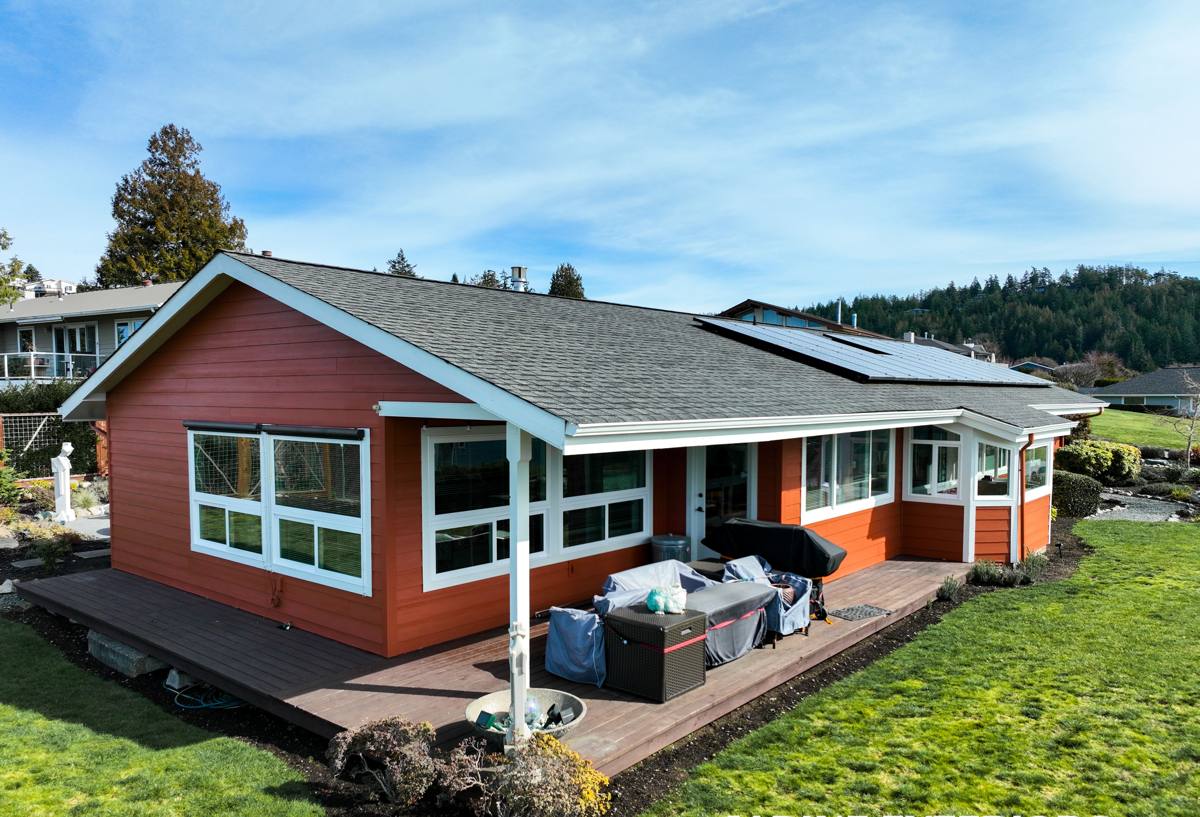
Moss isn't just a cosmetic nuisance. It holds water directly against the siding surface for weeks at a time, well past the point where the material would otherwise have dried. On materials that absorb moisture through their face or edges, that constant contact accelerates every failure mode — swelling, delamination, paint loss, and eventually rot or substrate breakdown. On a home in Nooksack, a north or west wall in the shade of trees or a neighboring structure can stay damp almost continuously from October through March.
Driving rain compounds the problem in a different way. Wind-driven water gets pushed up under laps, into seams, and behind trim in ways that vertical rain never would. If the siding, the flashing, and the water-resistive barrier behind it aren't detailed correctly, that water finds its way into the wall assembly — and once it's in, it doesn't leave quickly in a climate this humid.
Why This Matters More on Some Elevations Than Others
Not every wall of a Nooksack home takes the same beating. South and west elevations catch the brunt of driving rain during winter storms. North and east walls, especially anything shaded by trees or an adjacent building, hold moisture the longest and grow moss first. A correct installation accounts for this — it's not a one-size-fits-all job, and a crew that treats every wall identically is missing half the equation.
Why We Only Install James Hardie Fiber Cement
We install James Hardie fiber cement siding exclusively. We don't install vinyl, LP SmartSide, Cemplank, Allura, primed spruce, or cedar — not because those products don't have their place somewhere, but because we've made a professional decision about what stands up best to this specific climate, and we'd rather stand behind one system we know well than juggle several we don't.
Fiber cement is non-combustible, which matters increasingly across Washington. It's dimensionally stable, meaning it doesn't expand and contract the way wood-based products do when they cycle between soaked and dry — a cycle that happens constantly here. James Hardie's ColorPlus factory-finish system bakes color onto the board under controlled conditions, which holds up to UV and moisture far longer than field-applied paint, and it's backed by a real, transferable warranty that follows the house if it's sold.
Vinyl siding is cheap and low-maintenance, but it can warp in temperature swings, and it doesn't offer the same fire performance or the ability to hold a factory finish the way fiber cement does. Wood-based products like LP SmartSide use engineered strand technology that's come a long way, but it's still wood at its core — it can swell at cut edges and seams if moisture gets in, which is exactly the failure mode this climate is built to cause. Primed spruce and cedar require ongoing painting and sealing to keep water out, and in a place where the siding rarely gets a full dry week, that maintenance schedule gets away from people fast. Hardie removes that vulnerability at the material level, which is why it's what we put on homes in Nooksack.
What a Correct Installation Actually Involves
Fiber cement performs the way it's rated to perform only when it's installed to spec. A rushed or generic install — the kind that treats Hardie like any other lap siding — gives up most of the advantage the material offers.
The Details That Matter Most Here
- A drainage plane behind the siding — house wrap or building paper, lapped correctly, with a gap or rainscreen furring where the wall assembly calls for it, so any water that does get past the siding has somewhere to go besides the sheathing
- Flashing at every window, door, and horizontal transition, installed shingle-style so water is always directed outward and down, never trapped behind trim
- Correct fastener spacing and placement, driven straight and to the right depth — overdriven or underdriven nails are one of the most common causes of early field failures on fiber cement
- Proper clearance at grade, decks, patios, and roof lines — Hardie's own installation instructions specify minimum gaps, and skipping them is exactly how a wall starts wicking moisture from below
- Caulking only where James Hardie's instructions call for it, with a quality sealant — over-caulking traps moisture just as often as under-caulking lets it in
- Butt joints and seams treated with care, since these are the spots most likely to open up and take on water over time in a driving-rain climate
Every one of these details exists because someone, somewhere, found out the hard way what happens when they're skipped. In a climate like Whatcom County's, the margin for error on these details is smaller than it would be somewhere dry.
Our Process for a Nooksack Siding Project
We approach every siding job the same disciplined way, adjusted for the specific house and its exposure.
Assessment and Planning
We walk the exterior and evaluate each elevation separately — how much sun it gets, how much shade, how exposed it is to driving rain, and what condition the existing wall assembly is in underneath the current siding. This tells us where moisture has historically been a problem and where extra attention to flashing or drainage is warranted.
Tear-Off and Wall Prep
We remove the old siding down to the sheathing, check for any hidden rot or moisture damage, and repair or replace anything compromised before a single new board goes up. Installing new siding over a damaged wall just hides the problem — it doesn't solve it.
Weather Barrier and Drainage
We install a correctly lapped water-resistive barrier and, where the wall assembly calls for it, rainscreen furring to create a drainage gap behind the siding. This is one of the most important steps for a climate with this much sustained moisture.
Installation
Hardie boards go up to manufacturer spec — correct fastener pattern, correct clearances, correct flashing at every penetration and transition.
Finish and Walkthrough
Trim, caulking, and touch-up work close out the job, and we walk the property with the homeowner to review the finished work before we consider it done.
Choosing the Right Hardie Profile for a Nooksack Home
James Hardie's product lines give homeowners real options without sacrificing the performance this climate demands.
| Profile | Look | Best Suited For |
|---|---|---|
| HardiePlank lap siding | Traditional horizontal lap | Most home styles; the standard choice for full re-sides |
| HardiePanel vertical siding | Clean vertical lines | Modern or farmhouse-style homes, accent walls, gable ends |
| HardieShingle siding | Staggered or straight-edge shingle look | Craftsman-style homes, accent areas, dormers |
| HardieTrim boards | Smooth or textured trim | Window/door surrounds, corners, fascia |
All of these carry the ColorPlus factory finish option, which matters in a climate where field-painted surfaces take a beating from constant moisture. A factory-cured finish resists fading and moisture intrusion at the surface far better than paint applied on site, and it's worth the conversation before you settle on a color.
What Siding Installation Costs and What Drives the Price
Every home is different, but a few factors consistently move the price on a Nooksack siding project.
| Factor | Why It Matters |
|---|---|
| Tear-off and disposal of existing siding | More layers or difficult-to-remove material adds labor |
| Hidden wall damage | Rot or moisture damage found at tear-off requires repair before re-siding |
| Home size and wall complexity | More corners, dormers, and transitions mean more flashing and cutting |
| Profile and finish choice | ColorPlus finishes and specialty profiles cost more than standard primed boards |
| Trim and accent work | Detailed trim packages add labor beyond field siding |
| Access and site conditions | Steep lots, tight setbacks, or landscaping can slow the work |
We won't quote a number sight unseen — an accurate estimate requires a walk of the property — but we're always upfront about what's driving the cost before work starts, not after.
Keeping Hardie Siding Ahead of the Moss
Fiber cement is far more moisture-resistant than wood-based alternatives, but no siding is entirely maintenance-free in a climate this wet. A little attention goes a long way toward keeping a Nooksack home looking sharp year-round.
- Rinse shaded, moss-prone elevations once or twice a year with a garden hose or low-pressure wash — avoid high-pressure washing directly at seams and joints
- Trim back trees and shrubs that keep a wall in shade and slow its drying time after rain
- Check caulking at trim and penetrations annually and touch up anything that's cracked or pulled away
- Keep gutters clear so overflow doesn't run directly down the siding face
- Watch grade and landscaping near the foundation to make sure soil or mulch hasn't crept up to meet the bottom of the siding
Why Hire a Crew That Already Works in Nooksack
A siding crew that mostly works drier parts of the state can install a wall that looks perfect and still gets the details wrong for this climate — under-flashed transitions, skipped rainscreen gaps, clearances shaved too tight. Those mistakes don't show up on install day. They show up two or three wet seasons later, when water finds the gap nobody thought would matter.
We work Sumas, Nooksack, and the surrounding Whatcom County communities regularly, which means we're not guessing at how this valley's weather behaves — we're building to it every time we're on a roof or a ladder here. That's the difference between a siding job that looks good on day one and one that's still performing correctly ten wet seasons from now.
If your Nooksack home's siding is aging, showing moss, or you're planning ahead for a re-side, we're happy to walk the property and give you a straightforward, no-pressure estimate — just fill out the form below.