 Sumas Roofing
 Roofing Near the Huntingdon Border: What Makes This Area Different
Homes near the Huntingdon border crossing sit in one of the wetter, mossier stretches of Whatcom County. You're close enough to the Fraser Valley and the water to pick up salt-tinged air on top of the region's normal soaking rain, and the tree cover and low winter sun angle around here mean roofs stay damp far longer than roofs just a few miles south. That combination — moisture that lingers, plus salt exposure, plus a moss season that can run eight months or more — is hard on asphalt shingles that weren't installed with this climate in mind. It's not that asphalt shingle roofing is a bad fit for this area. It's that the installation details that don't matter much in a dry climate matter a great deal here.
We work roofs on both sides of this border corridor regularly, which means we're not guessing at what holds up. We see which shingles are still doing their job after ten winters and which ones failed early because a corner got cut on the parts nobody notices from the ground — the underlayment, the flashing, the ventilation.
Why Asphalt Shingles Still Make Sense Here
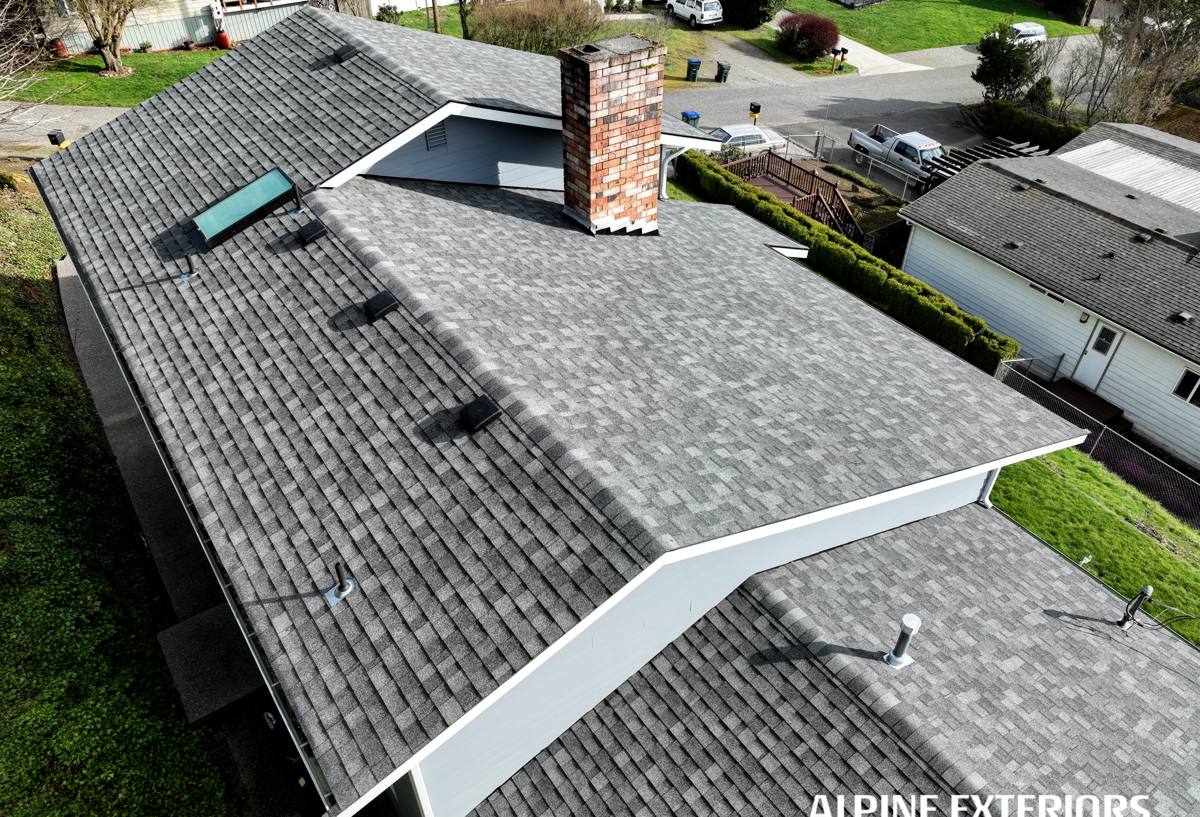
Asphalt shingle roofing remains the most common choice in Sumas and the surrounding area for good reason. It's a proven, well-understood system with a wide range of price points, it repairs easily if a section gets damaged, and modern architectural shingles hold up better against wind and moss than the three-tab shingles that were standard a generation ago. For most homes in this neighborhood, a properly installed asphalt shingle roof is the most sensible balance of upfront cost, appearance, and durability — as long as the moisture-management details underneath are done right.
Where Asphalt Shingles Fall Short if Installed Wrong
The failures we see in this area are almost never the shingle itself failing outright. They're moisture getting past the shingle layer because of a skipped step underneath — nailing too high, underlayment that doesn't lap correctly, valleys that were cut instead of woven or properly lined, or attic ventilation that traps humid air against the underside of the roof deck. In a drier climate those shortcuts might not show up for fifteen years. Here, with rain this frequent and moss growth this persistent, they show up in five to eight.
What a Correct Installation Involves in This Climate
A shingle roof built for this stretch of Whatcom County needs a few things that a generic installation might skip:
- Ice-and-water shield at eaves and valleys — not required by code everywhere, but cheap insurance against the wind-driven rain this area gets off and on all winter.
- Synthetic underlayment, properly lapped — a continuous secondary barrier so that if wind lifts a shingle edge or moss holds water against a seam, the deck stays dry underneath.
- Balanced intake and exhaust ventilation — soffit vents pulling air in, ridge or roof vents pushing it out, sized to the attic. This keeps the underside of the deck dry and slows the moss and algae growth that thrives on a roof that never fully dries between rains.
- Correct nailing pattern and placement — high-wind nailing per the shingle manufacturer's spec, not just "enough nails." This is the single most common corner cut we find on tear-offs.
- Metal flashing at every penetration and wall intersection — step flashing, counter-flashing, and properly formed valley or vent flashing, not roofing cement patched over a gap.
None of this is exotic. It's standard trade practice — but it takes longer and costs a little more in materials and labor than the stripped-down version, which is exactly why it gets skipped by crews pricing to win the lowest bid.
Moss and Algae: The Long Game
Moss doesn't just look bad — it holds moisture against the shingle surface and works its way under tabs and edges, which accelerates granule loss and can lift shingles over time. In an area with this much shade and dampness, moss isn't an if, it's a when. Zinc or copper strips near the ridge, kept clear gutters, and periodic gentle cleaning (never pressure washing, which strips granules) go a long way toward keeping a shingle roof looking and performing well for its full service life.
Ventilation and Attic Moisture: Often the Real Culprit
A surprising number of "roof leaks" we're called out for in this area turn out to be condensation problems, not leaks at all. Warm, moist household air rises into a poorly ventilated attic, hits the cold underside of the roof deck on a wet Whatcom County winter night, and condenses — soaking insulation and staining the deck in a pattern that looks a lot like a leak from outside. Fixing this means correcting the intake/exhaust balance, not just chasing shingles. We check attic ventilation as a standard part of every shingle roof estimate here, because in this climate it's often the difference between a roof that lasts its full warranty term and one that doesn't.
Our Process for a Huntingdon-Area Shingle Roof
- On-site inspection. We walk the roof (or use a drone where pitch or access makes that safer) and check the attic from inside — deck condition, ventilation, any signs of past moisture.
- Written scope and estimate. You get a clear breakdown of tear-off, underlayment, flashing, ventilation work, and shingle system — no vague lump-sum guessing.
- Tear-off and deck inspection. Old roofing comes off down to the deck so we can actually see what's there and replace any soft or rotted sheathing before it's covered up again.
- Underlayment and flashing installed first. This is the layer that actually keeps water out long-term; shingles are the wear surface on top of it.
- Shingle installation to manufacturer spec. Correct nailing pattern, exposure, and starter/ridge detailing for the wind and moisture load this area sees.
- Final walkthrough. We show you the finished work and go over basic maintenance — gutter clearing, moss watch points — before we call it done.
Comparing Underlayment and Ventilation Approaches
| Component | Minimum/Budget Approach | Approach We Use in This Climate |
|---|---|---|
| Underlayment | Basic felt, minimal lap | Synthetic underlayment with full manufacturer-spec overlap |
| Eave/valley protection | Standard underlayment only | Ice-and-water shield at eaves, valleys, and penetrations |
| Attic ventilation | Whatever exists already, unchecked | Intake/exhaust balance calculated and corrected as needed |
| Flashing | Reused where possible, cement-patched | New step and counter-flashing at all penetrations |
| Moss prevention | Not addressed | Zinc/copper strip option discussed at estimate |
Both approaches can use the same shingle product and look identical the day the job finishes. The difference shows up five to ten years later, which is exactly why it's worth asking a contractor which approach they're actually using — not just which shingle brand they're selling.
Repair, Replacement, or Maintenance: Knowing Which You Need
Not every roofing issue near the border area calls for a full replacement. Isolated shingle damage from a wind event, a single failed flashing point, or moss buildup on an otherwise sound roof are often repair or maintenance situations. A full replacement makes sense when the underlayment has failed broadly, when granule loss is widespread across multiple slopes, or when the roof is past its practical service life and repairs would just be chasing new leaks every winter. We'll tell you honestly which category your roof falls into — we don't have a reason to push a replacement a roof doesn't need.
Signs It's Time to Call Someone
- Granules collecting in gutters or at downspout outlets
- Shingles that look cupped, curled, or cracked, especially on south- or west-facing slopes
- Moss thick enough that you can see it lifting shingle edges
- Daylight visible through the attic roof deck, or damp insulation
- Staining on interior ceilings, even faint or intermittent
- A roof over 15-20 years old that hasn't had a professional inspection recently
Cost Factors for This Area
Pricing for asphalt shingle roofing depends on more than square footage. Roof pitch and complexity (number of valleys, dormers, and penetrations), deck condition once the old roofing is off, the shingle line chosen, and whether ventilation or flashing corrections are needed all factor in. We'd rather give you a real number after seeing your roof than a range that doesn't mean much until we know what's actually up there — but generally, a straightforward tear-off and reshingle on a typical single-family home runs into the mid-to-high five figures, with complexity, deck repair, and shingle grade moving that number up or down.
Why Local Experience on This Specific Corridor Matters
A roofing crew that mostly works drier inland areas doesn't build the same habits as one that works this border corridor week in and week out. We know which slopes in this area hold moss longest based on tree cover and sun exposure, we know how far wind-driven rain can push up under an eave in a hard Fraser Valley wind event, and we know which older homes in this area were built with ventilation that was fine for 1980s expectations but undersized by today's standard. That's not something you can shortcut by reading a spec sheet — it comes from doing this work, on these roofs, through enough winters to see what actually happens after the crew leaves.
If you're weighing a repair, a full shingle replacement, or just want an honest read on where your roof stands, we're glad to come take a look. Fill out the form below for a free, no-pressure estimate.