 Sumas Roofing
 Ferndale's Climate Is Hard on Windows — Here's Why
Ferndale sits close enough to the water that homes here deal with a different set of problems than windows fifty miles inland. Salt-laden marine air, long stretches of driving rain off the Salish Sea, and a moss season that can stretch from October through May all work on a window system in ways that show up slowly, then all at once. A window that's failing in Ferndale usually isn't failing because it's old — it's failing because it was never properly sealed, flashed, or matched to the conditions it has to live in.
Salt Air and Marine Moisture
Airborne salt accelerates corrosion on window hardware, screen frames, and any exposed metal fasteners or flashing. It also holds moisture against surfaces longer than dry inland air does, which means paint failures, wood swelling, and seal degradation all happen faster near the coast than they would in Sumas or further east in Whatcom County. Vinyl and fiberglass frames handle this better than bare aluminum or unprotected wood, but the bigger factor is almost always the installation, not just the material.
Driving Rain and Wind-Driven Water
Ferndale gets its share of storms where rain doesn't fall straight down — it's pushed sideways into the wall by wind, which means it hits window flanges and trim at an angle instead of just running off. A window that would be fine in a calm rain can leak under wind-driven rain if the flashing details weren't done correctly. This is the single biggest cause of the "mystery leak" homeowners call us about — water isn't coming through the glass, it's getting behind the frame at the flashing or sill.
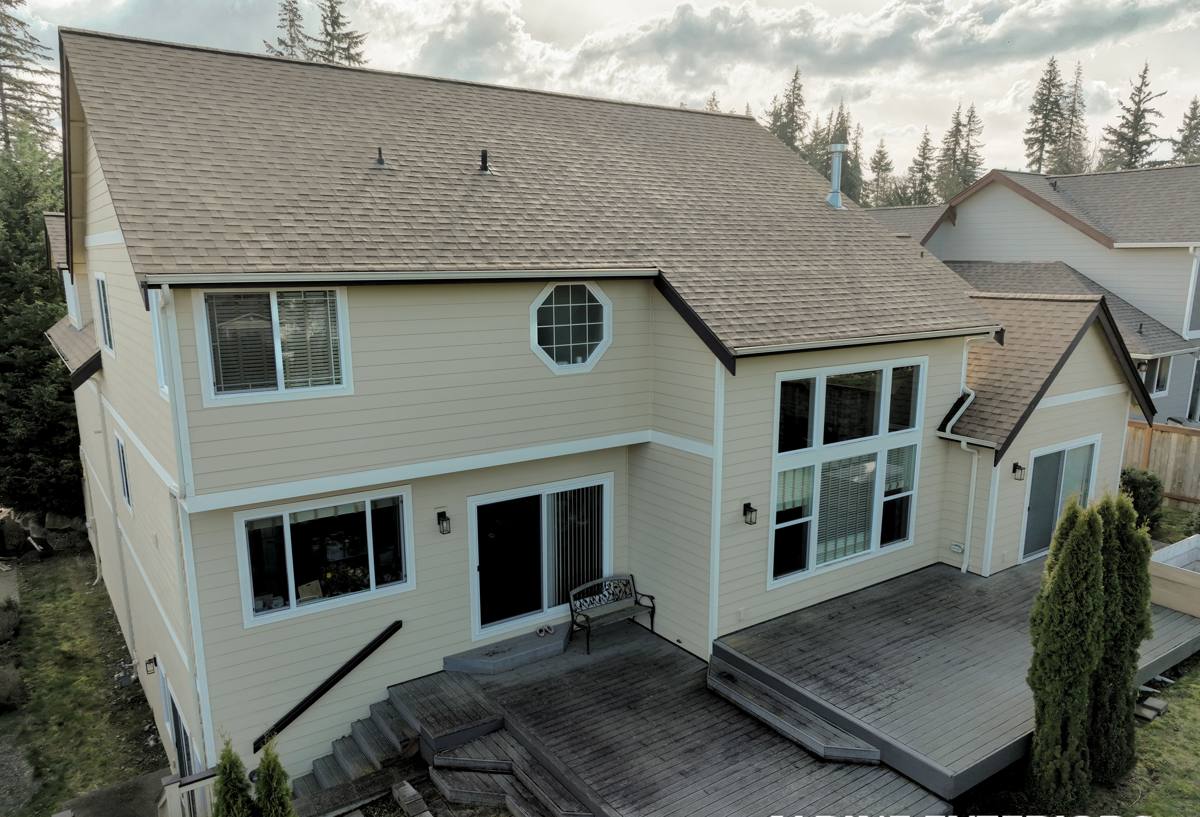
Signs a Ferndale Home Needs New Windows — or a Second Opinion
Not every problem window needs full replacement, and not every drafty room is actually the window's fault. Here's what we look for before recommending anything:
- Fogging or a permanent haze between the panes of a double-pane unit — the seal has failed and it can't be fixed, only replaced
- Soft or discolored wood at the sill or bottom corners, often the first place rot shows up
- Moss or dark green growth building up in the tracks or on exterior trim, a sign moisture is sitting where it shouldn't
- Windows that are hard to open, don't latch fully, or have visibly warped frames
- Noticeable drafts even with the window fully closed and locked
- Condensation forming on the interior glass regularly, especially in winter
- A jump in heating costs with no other explanation
What a Correct Window Installation Actually Involves
Setting a new window into an existing rough opening is not just "remove old, drop in new." The parts that actually determine whether a window performs for the next twenty years are mostly invisible once the trim goes back on. That's exactly why so many leak problems we get called out for trace back to a rushed install rather than a bad window.
Flashing and Water Management
Every opening needs a water management plan before the window ever goes in: a sloped sill pan to direct any water that gets past the frame back outside instead of into the wall, flashing tape or membrane integrated correctly with the house's weather-resistive barrier, and a shingle-style lap sequence so water is always directed downward and outward, never trapped behind a layer. Skipping or rushing this step is the number one reason a technically fine window still leaks.
Fit, Shimming, and Insulation
A window has to be shimmed square and plumb, not just wedged into the opening, or it will bind, leak at the corners, or fail its seals early from racking stress. The gap around the frame needs the right insulation — enough to stop air movement without overstuffing it, which can bow the frame inward and cause the sash to bind. Sealant on the exterior is the last line of defense, not the first, and it should never be asked to do the job flashing was supposed to do.
Comparing Window Materials for Whatcom County's Climate
There's no single "best" window material — there's a best fit for your home, your budget, and how much upkeep you want to take on. Here's how the common options stack up for a coastal, high-moisture climate like Ferndale's:
| Material | Moisture & Salt-Air Resistance | Maintenance | Typical Lifespan |
|---|---|---|---|
| Vinyl | Good — won't rot or corrode, but frames can expand/contract with temperature swings | Low | 20–30 years |
| Fiberglass | Very good — stable, doesn't corrode, holds up well to marine air | Low | 30-plus years |
| Wood (painted or clad) | Fair to good with cladding; bare wood is the most vulnerable to coastal moisture | Higher — painted wood needs regular upkeep | 20-plus years, depends on maintenance |
| Aluminum | Poor near salt air without a quality finish — prone to corrosion and condensation | Moderate | Varies widely |
For most Ferndale homes, we steer people toward vinyl or fiberglass because they hold up to salt air and moss-season moisture with the least ongoing maintenance. Wood-clad windows still have a place where the look matters and the owner is willing to keep up with it — that's an honest trade-off, not a knock on the material.
Our Window Installation Process
The process is the same whether it's one window or a whole house, because skipping steps is where problems start:
- On-site assessment of existing windows, framing condition, and any hidden rot or water damage
- Accurate measurement and product selection based on the home's exposure and your budget
- Careful removal of the old unit, checking the opening for damage before anything new goes in
- Repair of any rotted framing or sheathing found during removal — this gets flagged and priced honestly, not buried in the install
- Sill pan and flashing installed and tied into the existing weather-resistive barrier
- New window set square, shimmed, and fastened per manufacturer specs
- Insulation of the gap, exterior sealant, and interior/exterior trim finished to match the home
- Final walkthrough — operation, locks, and a look at the flashing details before we call it done
What Drives the Cost of a Window Installation Project
Every home is different, so we won't quote a number without seeing the job, but these are the factors that move the price up or down:
| Factor | Why It Matters |
|---|---|
| Number of windows | Per-window cost usually drops on larger jobs due to shared setup and travel time |
| Window type and size | Casement, double-hung, and larger or custom-shaped units cost more than standard sliders |
| Framing or rot repair | Hidden water damage found during removal adds labor and material that can't be known until the old window is out |
| Trim and siding tie-in | Matching existing trim profiles or siding cuts around the new opening adds time |
| Access | Second-story or hard-to-reach windows take longer and may need staging or lifts |
| Egress requirements | Bedroom windows that need to meet egress sizing may require a different unit or opening adjustment |
Why Hiring a Crew That Already Works in Ferndale Matters
Window installation isn't just a glass-and-frame trade — it's a water management trade, and that's exactly the skill set roofing work builds every day. A crew that spends most of its time solving flashing, valley, and drip-edge problems on roofs brings that same eye for where water actually goes to a window opening. We're not guessing at how wind-driven rain behaves against a wall in Whatcom County — it's the same physics we deal with on every roof we flash.
There's also a practical side to local experience: knowing what permitting looks like for window replacement in this area, knowing which older Ferndale homes tend to have out-of-square openings or hidden rot from decades of coastal moisture, and knowing which products actually hold up here versus which ones look fine on paper but struggle in a marine climate. That's knowledge you build by doing the work locally, not by reading a spec sheet.
Maintaining Your Windows Through Moss Season
A good installation buys you decades of performance, but a little seasonal upkeep protects that investment — especially once moss season sets in and things stay damp for months at a stretch:
- Clear moss and debris out of window tracks and weep holes so water can actually drain
- Check exterior caulking once a year for cracking or gaps, especially on the sun-exposed and weather-facing sides of the house
- Keep vegetation and overhanging branches trimmed back so windows and trim can dry out between rains
- Wipe down interior sills if you notice regular condensation, and address the underlying humidity if it keeps happening
- Test locks and operation each season — a window that's hard to latch fully isn't sealing fully either
If you're dealing with a drafty, foggy, or moss-stained window in Ferndale, we're happy to take a look and give you a straight, no-pressure estimate — no obligation, just an honest read on what your home actually needs. Use the form below to get started.