 Sumas Roofing
 Windows Built for a Border-Climate House
Huntingdon sits right against the international line from Sumas, and the houses on both sides of that line deal with the same weather. Whatcom County winters bring long stretches of driving rain, damp air that never quite dries out, and a moss season that seems to start earlier every year. Windows here don't fail because of one bad storm — they fail slowly, from months of moisture working into places it shouldn't be. An energy-efficient window in this climate isn't just about a lower heating bill. It's about a frame and seal system that can shed wind-driven rain, resist the salt-tinged air moving in off the Sound, and still perform after a decade of soggy Novembers.
We treat Huntingdon as part of our regular service area, not an afterthought tacked onto a Sumas route sheet. That matters more than it sounds like it should, because window work here has its own quirks — older housing stock, a mix of Canadian and U.S. product availability, and a climate that punishes shortcuts faster than drier parts of the country ever would.
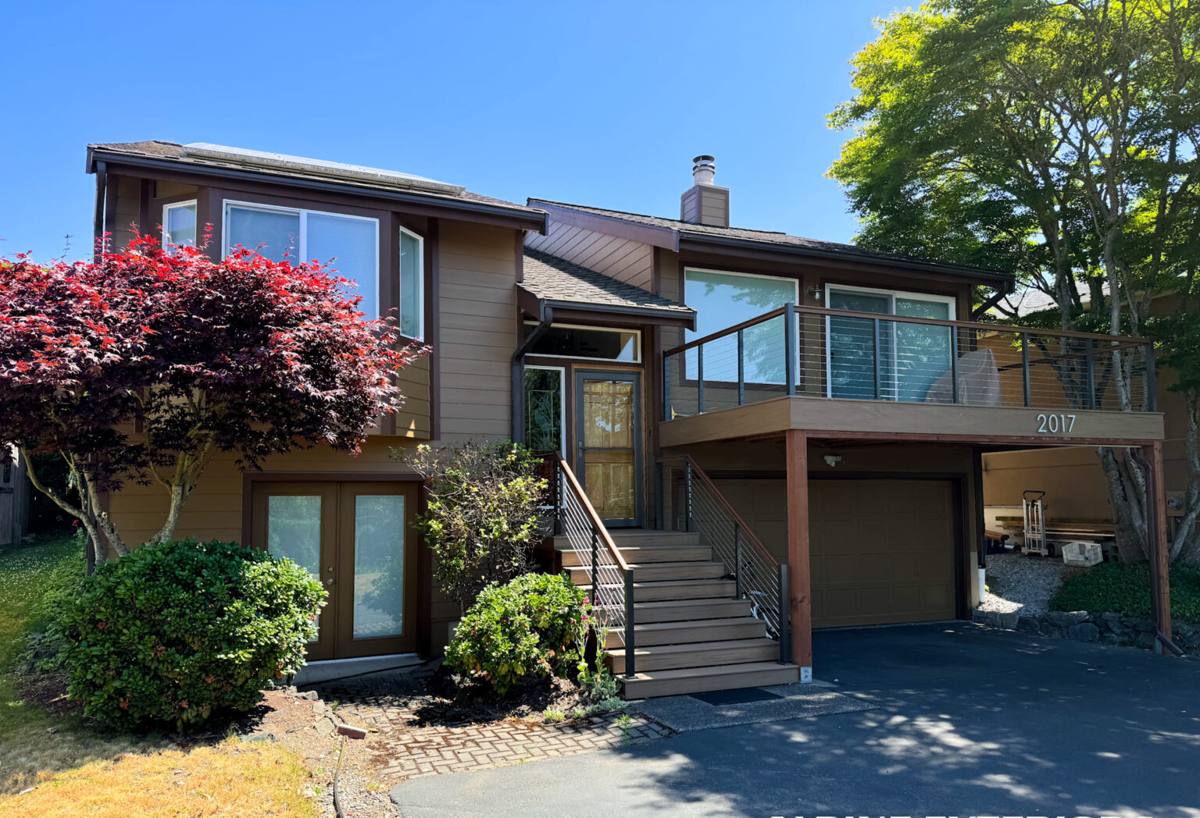
What Driving Rain and Moss Season Actually Do to a Window
Most window failures we see in this area aren't glass failures — they're perimeter failures. Wind-driven rain doesn't fall straight down; it gets pushed sideways into the wall assembly, and if the flashing and sealant details around a window aren't right, water finds the gap between the frame and the rough opening. From there it soaks framing lumber, saturates insulation, and shows up months later as a soft spot on the interior sill or a musty smell in the wall.
Moss and algae add a second, slower problem. On north-facing walls and anywhere shaded by trees or eaves, organic growth holds moisture against the frame longer than it would otherwise sit there. On wood and some composite frames, that constant dampness accelerates rot at the corners and along the bottom rail — exactly the spots where seals are already under the most stress. Older aluminum-frame windows, common in homes built a few decades back, have their own issue: they conduct cold straight through the frame, which shows up as condensation and eventually mildew on the interior trim during cold snaps.
The Warning Signs We Look For First
- Soft or discolored wood at the sill or bottom corners of the frame, inside or out
- Condensation forming between the panes (a sign the seal between the glass layers has failed)
- Persistent moss, algae, or black staining on the frame or nearby trim that keeps returning after cleaning
- Drafts you can feel with a hand near the frame on a windy day, even with the window latched
- Paint or caulk that's cracked and pulling away from the frame rather than sitting flush
- Difficulty latching or sliding the sash, which often points to a frame that's swelled or warped from moisture
What "Energy-Efficient" Actually Means for This Climate
Energy-efficient windows are rated on a few key numbers, and the ones that matter most shift depending on climate. In a marine climate like ours, the U-factor — how much heat escapes through the window — usually matters more than the solar heat gain coefficient, since we're managing damp cold more often than intense sun. Look for:
- U-factor: lower is better for heat retention; this is the number that matters most for our winters
- Low-E coatings: a thin, transparent layer that reflects heat back into the room without cutting visible light
- Gas-filled insulated glass units: argon fill between panes slows heat transfer compared to plain air
- Warm-edge spacers: the material separating the glass panes at the edge; a poor spacer creates a cold line where condensation and eventual seal failure start
Frame Material Comparison for a Wet, Salt-Tinged Climate
| Frame Material | How It Handles This Climate | Maintenance |
|---|---|---|
| Vinyl | Doesn't rot, resists moisture well; performance depends heavily on quality of the weld and reinforcement | Low — occasional cleaning, no repainting |
| Fiberglass | Very stable in temperature swings, holds up well to sustained damp exposure | Low to moderate |
| Wood-clad | Attractive interior look, but the cladding seams and any exposed wood are vulnerable if seals fail | Higher — needs monitoring at joints and sills |
| Aluminum | Durable but conducts cold, leading to condensation and interior moisture issues in our winters | Moderate; thermally broken versions perform better |
We don't push one material on every home. A lot depends on the wall assembly, sun exposure, and what the rest of the house is doing — but we'll walk you through the honest trade-offs for your specific windows rather than defaulting to whatever's easiest to install.
What a Correct Installation Actually Involves
The window itself is only part of the equation. Most of the failures we get called out to fix trace back to installation shortcuts, not product defects. A correct install in this climate means the water management details are done in the right order, every time.
- A sloped sill pan under the window so any water that does get past the frame drains back outside instead of pooling
- Flashing tape integrated with the house's weather-resistive barrier in the correct shingle-lap order (bottom, sides, then top) so water is always directed downward and outward
- Backer rod and a proper exterior sealant bead — not just caulk smeared over a gap — at all frame-to-siding joints
- Low-expansion foam or mineral wool in the shim space, avoiding standard spray foam that can bow a frame out of square
- Interior air sealing so warm, moist indoor air isn't driven into the wall cavity where it can condense
- A final check that the window is plumb, level, and square before anything is finished over it — a slightly racked frame will telegraph problems for years
Our Process, Start to Finish
- Assessment: we look at the existing windows, the wall assembly where visible, and any signs of past moisture problems before recommending anything
- Product selection: we go over frame material, glass package, and performance ratings against your budget and the specific exposure of each window opening
- Scheduling: we plan around weather windows, since flashing and sealant work needs a reasonably dry stretch to install correctly
- Removal: old units come out carefully, and we inspect the rough opening for hidden rot or damage before anything new goes in
- Installation: sill pan, flashing, shimming, and sealing done in sequence, not skipped or rushed
- Finish work: interior and exterior trim, caulking, and touch-up so the opening looks finished, not patched
- Walkthrough: we test operation, check the seals, and clean up the work area before we consider the job done
Why a Crew That Already Works Huntingdon, BC Matters
Huntingdon is a small border community, and the housing stock there tends to be older — which means we're regularly dealing with original wood or early-generation aluminum windows that haven't been touched since the house was built. Knowing that going in changes how we quote and schedule a job, because we're rarely just swapping glass; we're often addressing frame damage that's been building for years.
There's also the practical reality of the border itself. A crew that only occasionally crosses over tends to underestimate scheduling and logistics — timing appointments, moving materials and equipment, and being upfront about what that adds to a project. We handle that as a normal part of doing business here rather than treating Huntingdon as a special case, which means fewer surprises and a more accurate timeline from the first estimate.
Familiarity with the area also means we've seen how the local exposure plays out house by house — which walls take the worst of the driving rain, where moss holds on longest through the year, and which older window lines in the neighborhood tend to fail at the seals first. That's the kind of thing you only pick up by actually working the area repeatedly, not from a one-off job.
What Affects the Cost
We won't quote a number without seeing the windows, but the factors that move the price are consistent from job to job:
| Factor | Why It Changes the Price |
|---|---|
| Frame material | Vinyl is generally the most budget-friendly; fiberglass and wood-clad cost more up front |
| Number and size of openings | Larger openings and specialty shapes take more time and material |
| Condition of the rough opening | Hidden rot or framing damage found during removal adds repair work before the new window goes in |
| Access and height | Second-story or hard-to-reach windows take longer to stage and install safely |
| Glass package | Upgraded low-E coatings, gas fills, or triple-pane glass add cost but improve long-term performance |
Broadly speaking, energy-efficient replacement windows in this region tend to fall in a mid-range per-window cost once you account for quality materials and correct installation — but the honest answer is that it varies enough by house that a walk-through beats any ballpark number.
Ready When You Are
If your windows in Huntingdon are drafty, fogged between the panes, or showing soft spots at the sill, it's worth having someone look at them before another wet season sets in. We offer free, no-pressure estimates — no obligation, just an honest look at what your windows need and what it would take to fix it right. Fill out the form below and we'll get in touch to schedule a time that works.