 Sumas Roofing
 Roofing in Huntingdon, BC: What the Local Climate Actually Demands
Huntingdon sits right at the Sumas–Huntingdon border crossing, sharing the same weather system that moves through Whatcom County and the lower Fraser Valley. That means long, wet winters, a moss season that can stretch from fall through spring, and driving rain that comes in sideways off the valley more often than most homeowners expect. Add in salt-tinged marine air working its way inland from the Salish Sea, and you have a climate that is genuinely hard on a roof — not because any one storm is extreme, but because the moisture never really stops.
A roof built for a drier climate, or installed without attention to this area's specific moisture load, tends to fail early. Underlayment breaks down, fasteners corrode faster than expected, and moss gets a foothold in shaded, north-facing sections before anyone notices. A new roof installation here isn't just about putting on fresh material — it's about building in the moisture management this specific location requires from day one.
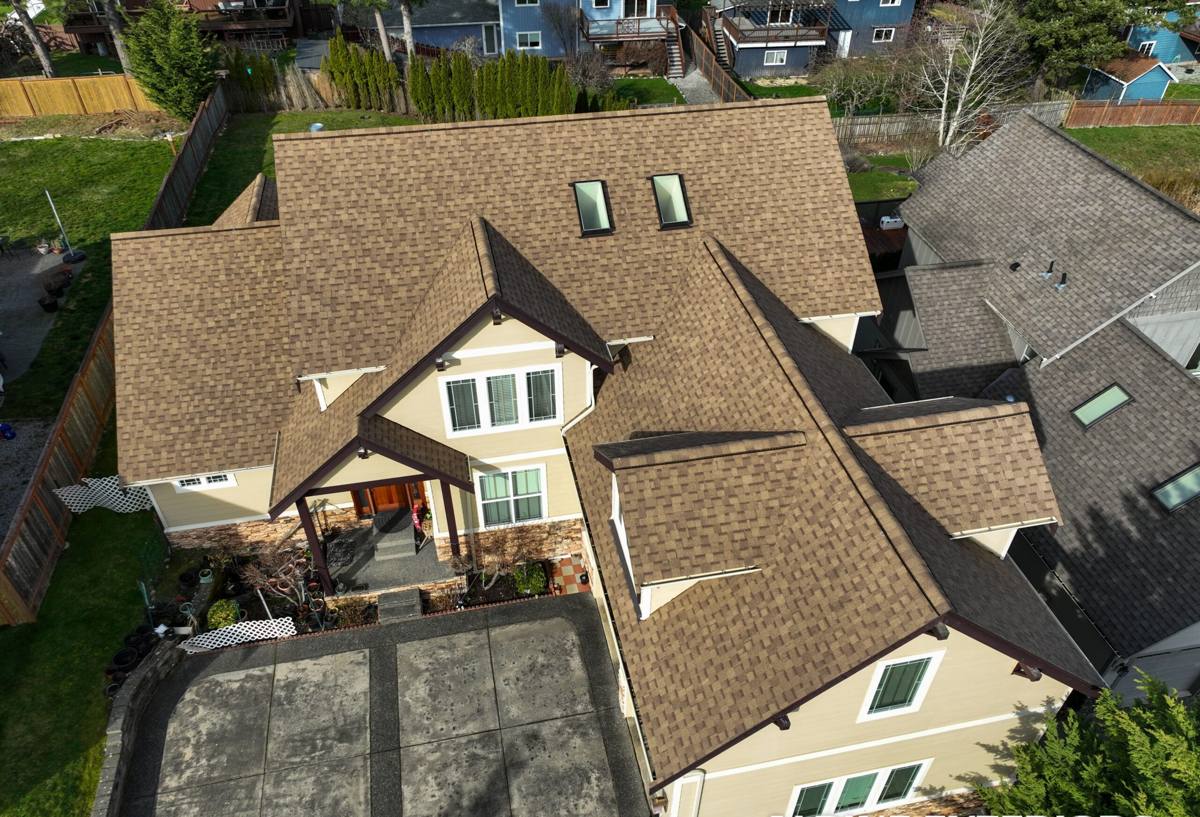
Signs Your Huntingdon Roof Needs Full Replacement, Not Another Repair
Homeowners often patch the same problem two or three times before realizing the roof itself, not any single leak, is the issue. A few honest signs it's time to talk replacement instead of another repair call:
- Granule loss heavy enough that you can see bare asphalt in spots, especially on south- and west-facing slopes
- Shingles that are curling, cupping, or cracking across large sections rather than one isolated area
- Repeated leaks in different locations each time it rains hard, rather than the same spot
- Thick, established moss or algae staining that keeps coming back within a season or two of cleaning
- Visible sagging in the roof deck, or soft spots you can feel when walking the attic
- A roof that's approaching or past the manufacturer's rated lifespan, regardless of how it looks from the ground
Any one of these on its own might still be repairable. Two or three together, especially on an older roof, usually means the underlying materials have reached the point where repairs stop being cost-effective.
What a Correctly Installed New Roof Actually Involves
Tear-Off and Deck Inspection
A proper installation starts with removing the old roofing down to the deck — not layering new shingles over old ones. This is the only way to actually see the plywood or OSB underneath, check for rot or delamination around vents and valleys, and replace any damaged sections before they're covered up and forgotten for another 20 years.
Underlayment and Moisture Protection
In a climate that sees this much sustained rain, underlayment choice matters more than most homeowners realize. Ice-and-water shield along eaves, valleys, and any low-slope transitions gives a second line of defense against wind-driven rain and any ice that forms during a cold snap. This is the layer that does the real work if the outer roofing ever gets compromised.
Flashing at Every Penetration
Chimneys, skylights, vent pipes, and roof-to-wall transitions are where the overwhelming majority of leaks actually start — not in the open field of the roof. New, properly step-flashed and counter-flashed details at every one of these points is non-negotiable on a correct installation, not an upgrade.
Attic and Roof Ventilation
Balanced intake and exhaust ventilation keeps the attic close to outdoor temperature, which reduces condensation buildup on the underside of the deck and helps prevent the ice damming that can form during a cold stretch. It also extends the life of the shingles themselves, since trapped heat and moisture accelerate wear from underneath.
Material Installation to Manufacturer Specification
Nail placement, exposure, and fastening pattern all affect whether a roofing material's warranty is actually valid. Rushed installs that miss these details void coverage even when the shingle or panel itself is fine — the workmanship is what fails, not the product.
Choosing a Roofing Material for This Climate
There's no single "best" material for every home — it depends on the roof's pitch, the home's style, and how much long-term maintenance you want to take on. Here's how the common options compare for a moisture-heavy, moss-prone climate like this one:
| Material | Typical Lifespan | Moss & Moisture Behavior | Relative Cost | Best Fit |
|---|---|---|---|---|
| Architectural asphalt shingle | 25–30 years | Good with algae-resistant granules; needs periodic moss treatment | Lower | Most residential homes, straightforward budgets |
| Standing seam metal | 40–50+ years | Sheds moisture fast, very moss-resistant on steeper pitches | Higher | Homeowners planning to stay long-term, steeper roofs |
| Cedar shake | 20–30 years with upkeep | Attractive but moisture-sensitive; needs regular maintenance to resist rot | Higher | Homeowners committed to ongoing upkeep for the look |
| Synthetic/composite shake | 30–50 years | Mimics cedar's look with far better moisture resistance | Mid-to-higher | Homeowners who want the cedar aesthetic without the maintenance burden |
We'll walk through these trade-offs honestly during your estimate — including where a lower-cost option is genuinely the right call, not just the cheaper one.
How Our Installation Process Works
- On-site inspection and written estimate — we get on the roof, check the deck where accessible, and give you a clear, itemized quote, not a ballpark guess.
- Material selection — we go through the options above based on your budget, roof pitch, and how long you plan to stay in the home.
- Scheduling and permitting — we handle the paperwork for your side of the border before any crew shows up.
- Tear-off and deck repair — full removal of the old roof and replacement of any compromised decking, done in one continuous day where roof size allows.
- Underlayment, flashing, and material installation — installed to manufacturer spec so your warranty is actually intact.
- Site cleanup — magnetic sweep for nails and full debris removal before we consider the job done.
- Final walkthrough — we go over the finished roof with you and hand over warranty paperwork.
Why a Crew That Already Works Huntingdon, BC Matters
Huntingdon isn't a typical service-area add-on for us — it's part of the same community we work in every week. Being based in Sumas, WA means we're minutes from the border crossing, not driving in from across the county for a single job. That proximity translates into faster scheduling, quicker response if something needs a second look after a storm, and a crew that already understands how this particular stretch of the border area is built — older housing stock, the way certain streets catch more wind, which roof lines tend to hold moss longest through the winter.
It also means we're used to working across the practical realities of a border community: coordinating logistics on both sides, being upfront about which permitting and inspection process applies to your specific address, and not treating Huntingdon as an afterthought tacked onto a Whatcom County service list. A crew that's actually familiar with your street beats one that's guessing.
What Affects the Cost of a New Roof in This Area
| Factor | Why It Moves the Price |
|---|---|
| Roof size and pitch | More surface area and steeper pitches both increase material and labor time |
| Material choice | Asphalt runs lowest up front; metal and synthetic shakes cost more but last longer |
| Layers to remove | Tearing off multiple existing layers takes more labor than a single-layer roof |
| Deck condition | Rotted or soft decking found during tear-off requires replacement before new roofing goes on |
| Access and complexity | Steep pitches, multiple valleys, and tight lot access all add labor time |
| Ventilation upgrades | Adding or correcting intake/exhaust venting is a smart long-term investment, not just an add-on cost |
We'll give you a real number after seeing your roof — not a phone estimate. What we can tell you honestly upfront is that the cheapest bid on paper is rarely the cheapest roof over 20 years, especially in a climate this hard on shortcuts.
After Installation: Protecting Your New Roof
A correctly installed roof still needs basic upkeep to hit its full lifespan in this climate. A short list worth keeping on the fridge:
- Clean gutters at least twice a year so water isn't backing up under the roof edge
- Have moss treated before it establishes, not after it's already thick and staining shingles
- Check attic ventilation isn't blocked by insulation or debris
- Have flashing and roof penetrations checked after any unusually severe windstorm
- Avoid pressure washing the roof surface — it strips protective granules and can force water under shingles
- Trim back tree limbs that overhang the roof to cut down on shade, debris, and moss growth
- Schedule a quick professional look every couple of years, even with no visible problems
If your roof in Huntingdon, BC is showing its age or you're weighing a replacement against another round of repairs, we're happy to take a look and give you a straight answer — no pressure, no upsell. Fill out the form below for a free estimate from a crew that already knows this area.