 Sumas Roofing
 Why Lynden Siding Has to Work Harder Than the Brochure Photos Suggest
Lynden sits in the part of Whatcom County where marine air off the Salish Sea meets farmland weather — long wet winters, a short dry summer window for exterior work, and enough standing moisture in the shoulder seasons to keep moss and algae established on north-facing walls for months at a time. Siding here isn't decorative. It's the single largest weatherproofing system on the house, and it's asked to hold up to driving rain, salt-tinged marine air, and near-constant humidity for most of the year.
Homeowners who've lived in Lynden a while already know the tells: paint that chalks and peels years early, trim that goes soft at the joints, and green-black streaking on siding that never gets direct sun. None of that is inevitable. It's what happens when a siding product or an installation detail wasn't built for this specific climate load.
What "climate load" actually means for a wall
It's not just rainfall totals. It's how long a wall assembly stays wet after a storm, how much bulk water gets driven sideways into laps and seams by wind, and how much ambient moisture the material itself absorbs and releases every day of the moss season. A product that performs fine in a dry climate can fail quietly here — not by falling off the house, but by trapping moisture behind it for years before anyone notices.
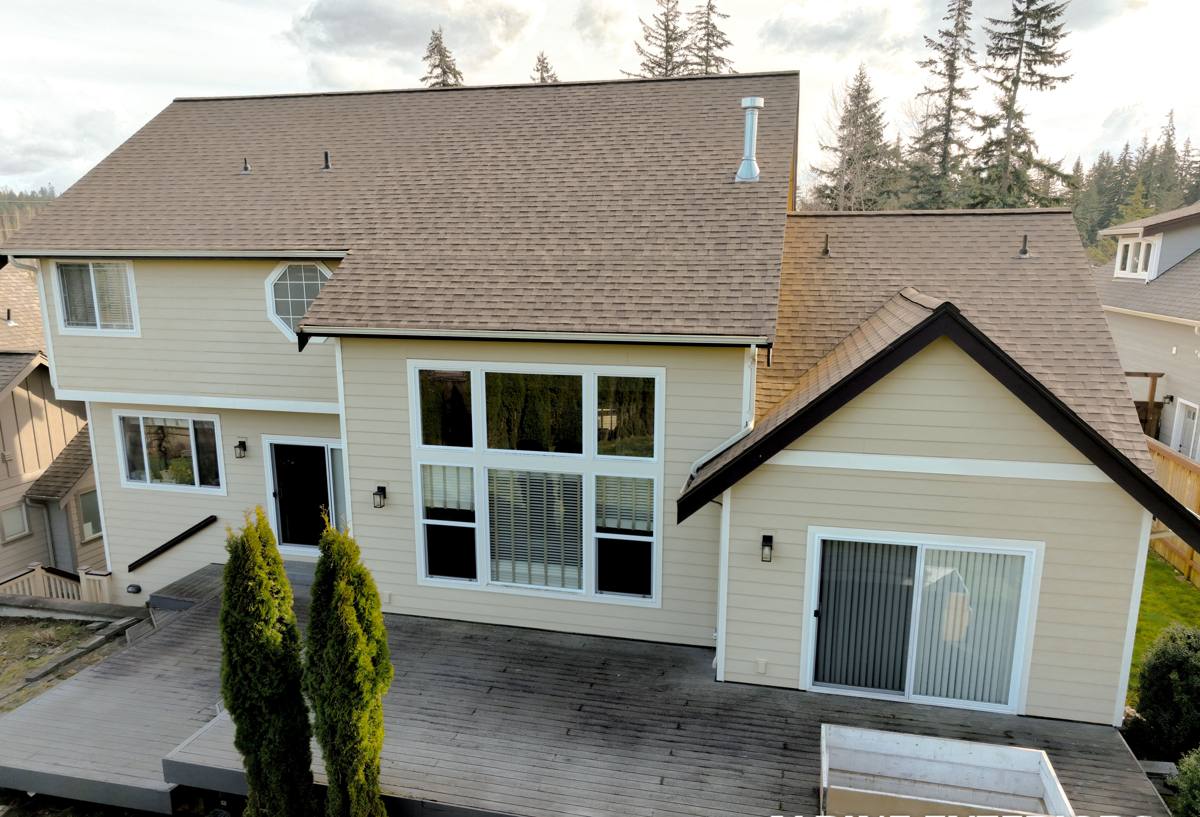
Why We Install Only James Hardie Fiber Cement Siding
We don't install vinyl, LP SmartSide, primed spruce, cedar, or other fiber cement brands like Cemplank or Allura. That's not a marketing position — it's a standard we set because James Hardie is the product we're comfortable putting our name behind on a house that has to survive decades of Whatcom County winters.
Fiber cement itself is a mature, well-understood category, and other brands make a reasonable product. What we look for is consistency: dimensional stability that doesn't vary batch to batch, a factory finish that's actually engineered for UV and moisture exposure rather than field-applied paint, and a manufacturer with enough of a track record in the Pacific Northwest that we're not guessing how it behaves ten years out. James Hardie is the one that's cleared that bar for us on every job we've done in this region.
What we're not saying
We're not telling homeowners that every other siding product is defective. Vinyl is inexpensive and low-maintenance in mild climates; wood has a look some homeowners genuinely prefer and are willing to maintain for. What we're saying is that after years of installing and repairing siding in this specific climate, fiber cement — and specifically James Hardie's engineered lines — is the product we trust enough to stand behind with our own installation warranty.
James Hardie's Climate-Engineered Lines and Why That Matters Here
James Hardie makes region-specific formulations rather than one product for the whole country. In wetter regions like ours, that means an HZ5 product engineered for high-moisture, freeze-adjacent climates, paired with a ColorPlus factory finish baked on under controlled conditions rather than sprayed or brushed on site after installation.
| Feature | Why It Matters in Lynden |
|---|---|
| HZ5 climate engineering | Formulated for high-moisture, high-humidity regions rather than a generic national spec |
| ColorPlus factory finish | Cures under controlled heat, resists the chalking and early fade common on field-painted siding here |
| Non-combustible fiber cement | Doesn't support the moisture-driven rot cycle that wood and some composite products face |
| Dimensional stability | Resists the swelling and shrinking cycle triggered by our wet-to-dry seasonal swing |
| Transferable warranty | Coverage that survives a home sale, which matters in a market where houses change hands |
The color finish point is worth dwelling on. A lot of siding failures we see aren't the substrate failing — they're the paint failing first, then water getting behind a compromised finish. ColorPlus is cured at the factory in a way a field-applied coat can't replicate, and it's the reason Hardie siding in this climate tends to hold its color and seal integrity years longer than repainted alternatives.
What a Correct Installation Actually Involves
James Hardie siding fails early almost exclusively because of installation shortcuts, not product defects. In a climate like ours, the margin for error on water management details is smaller than in drier regions, because a small gap or missed flashing detail gets tested by rain dozens of times a year instead of a handful.
Water management, not just cladding
- Proper weather-resistant barrier installed and lapped correctly behind the siding, not just stapled up as an afterthought
- Flashing at every horizontal transition — window heads, roof-to-wall intersections, deck ledgers — installed to shed water outward, not into the wall cavity
- Correct minimum clearance from grade, decks, and roof lines so siding isn't sitting in a splash zone or holding standing moisture
- Butt joints and panel seams sealed or flashed per Hardie's published fastening and joint details, not just caulked and hoped for
- Fasteners set to the manufacturer's spec — over-driven or under-driven nails are one of the most common causes of early siding failure
Fastening and clearances
James Hardie publishes exact fastener spacing, edge distance, and nailing patterns for each product line, and those specs change slightly depending on exposure category and whether the wall is a standard or engineered assembly. Skipping these details doesn't usually show up as a problem in year one — it shows up in year five or six as buckling, popped fasteners, or water staining at the laps, right when it's expensive to trace back to the install.
Our Process on a Lynden Job
- Walk-through and assessment — we look at the existing siding, moisture staining, trim condition, and any rot or soft spots before quoting anything
- Product and color selection — matched to the home's exposure (north walls and shaded sides get extra attention given our moss season)
- Written estimate — scope, product line, and a realistic timeline, with no vague allowances hiding behind the number
- Prep and tear-off — removing old siding down to sheathing, checking for hidden moisture damage before anything new goes up
- Weather barrier and flashing installation — the step that determines whether the siding lasts 10 years or 40
- Hardie installation to manufacturer spec — correct fastening, clearances, and joint treatment throughout
- Final walk-through — checking trim, caulking, and finish details before we consider the job done
Cost Factors on a Lynden Siding Job
We don't publish blanket per-square-foot pricing because it depends heavily on what's underneath the old siding, but these are the variables that move the number most:
| Factor | How It Affects Cost |
|---|---|
| Existing wall condition | Rot or moisture damage found during tear-off adds sheathing repair before new siding can go on |
| Home size and wall complexity | More corners, gables, and trim detail means more labor and material cutting |
| Product line chosen | Lap siding, panel siding, and shingle-style Hardie products carry different material and labor costs |
| Trim and accessory scope | Full trim replacement alongside siding costs more than reusing sound existing trim |
| Access and site conditions | Two-story walls, tight lot lines, and landscaping obstacles add labor time |
Signs a Lynden Home's Siding Needs Attention
- Persistent moss or algae growth on siding that never fully dries between rains
- Paint that's chalking, peeling, or fading noticeably faster on one side of the house
- Soft or spongy spots when you press on siding or trim near ground level
- Visible gaps opening up at butt joints or around window and door trim
- Warping, buckling, or panels that no longer sit flat against the wall
- Interior signs — musty smell or staining on interior walls that share an exterior wall with suspect siding
Any one of these on its own might be minor. Two or three together, especially on a wall that gets little sun, usually means water has been getting behind the cladding for a while.
Why a Crew That Already Works Lynden Matters
Installation details that work fine in a drier climate can be inadequate here, and a crew that mostly works inland or in milder markets may not default to the flashing and clearance details that matter most in Whatcom County's wet season. A crew that's done this work repeatedly in Lynden and the surrounding Sumas area already knows which walls take the worst weather exposure, how long the moss season actually runs, and where the moisture problems tend to start on homes of this area's typical age and construction. That's not something a manufacturer spec sheet alone teaches — it's pattern recognition built from doing the work locally, house after house, through the same weather the next job will face.
If your Lynden home's siding is showing its age, or you're planning ahead for a replacement, we're happy to take a look and give you a straight, no-pressure estimate — no guesswork on product, no vague scope. Fill out the form below and we'll get back to you.