 Sumas Roofing
 Why Siding Repair Looks Different in Nooksack
Nooksack sits in the Nooksack River valley in the northeast corner of Whatcom County, close enough to the border and the foothills that the weather here behaves a little differently than it does out along the water. The same marine air mass that carries salt off the Sound still reaches inland this far, and it arrives layered with driving rain, low winter sun that never quite dries a north wall, and a moss season that can run eight months or more. On siding, that combination doesn't show up as one dramatic failure. It shows up as a slow accumulation: a joint that stayed damp one season too long, a patch of moss that held moisture against the board through a wet winter, a caulk line that finally gave up after enough freeze-thaw cycles.
That's the case for treating siding repair as its own skill, not a smaller version of a full re-side. A repair has to solve the actual water problem behind the damaged section, match the existing material and finish closely enough that it doesn't stand out, and hold up under the next round of the same weather that caused the failure in the first place. Done wrong, a repair just buys a house a year or two before the same spot fails again.
What we typically find during an inspection
On repair calls in this part of Whatcom County, a handful of patterns show up again and again: moss colonies bridging a butt joint and wicking water behind the board, cracked or missing caulk at trim and window returns, faint staining below a lap where wind-driven rain has been finding a gap, and nail heads that have started to back out after repeated wet-dry cycling. On older wood-based or engineered siding, we'll also check for soft, spongy spots, which usually mean water has already reached the substrate.
Common Culprits: What Actually Damages Siding Here
Most repair calls trace back to one of a short list of causes, and knowing which one you're dealing with changes the whole scope of the fix.
- Moss and organic growth — holds moisture against the siding far longer than open air would, and its root structure can pry at seams and caulk over time.
- Wind-driven rain — Whatcom County storms don't always fall straight down; wind pushes rain sideways into laps, trim returns, and any joint where flashing or caulk has failed.
- Freeze-thaw cycling — a wet joint that freezes expands, and repeated cycles through a Nooksack winter will eventually crack caulk and open gaps that weren't there before.
- UV and weathering — thins paint film over years, especially on south and west exposures, until the substrate underneath is no longer protected.
- Original installation shortcuts — insufficient ground or roofline clearance, missing or undersized flashing, and joints caulked where the manufacturer's spec calls for them to be left open. These aren't always obvious until a section starts failing.
What a Correct Siding Repair Actually Involves
A repair that's done right starts with tracing the water, not just covering the damage. Pulling the failed board and stopping there, without figuring out how water got behind it, is how the same spot ends up back on a repair list two winters later.
The steps that separate a lasting repair from a patch job
- Identify the actual entry point — a failed caulk joint, missing flashing, or a clearance problem — before closing anything back up.
- Match the repair material to what's already on the house, including profile, exposure, and fastening pattern.
- Hold to manufacturer clearance and fastening specs on the repair itself, even when it's a single board — a repair installed to the same shortcuts that caused the original failure won't outlast it.
- Refinish to match, using factory-matched color where the product allows it, or a proper field-paint match where it doesn't.
- Only caulk the joints that are supposed to be caulked. Sealing a joint that's designed to drain is one of the more common causes of repeat failures we see.
When repair makes sense, and when it doesn't
Repair is the right call when the damage is localized — an impact spot, a single failed joint, moisture confined to one section — and the wall assembly behind it is otherwise sound. Replacement starts to make more sense when moisture has clearly traveled behind multiple boards, when the sheathing or water-resistive barrier is compromised across a wider area, or when an older wood-based or engineered product is failing broadly rather than in one spot. Part of an honest estimate is telling you which situation you're actually in, not defaulting to the bigger job.
Our Nooksack Repair Process
- On-site assessment. We look at the damaged area and the surrounding siding, checking for moisture, soft spots, and signs the problem extends further than what's visible.
- Trace the water path. Before pricing anything, we identify why water got in — a flashing gap, a clearance issue, failed caulk — so the fix addresses the cause.
- Written scope and estimate. You get a clear description of what's being repaired, what material will be used, and why, before any work starts.
- Careful removal. Damaged boards come off without disturbing more of the surrounding siding than necessary, and we inspect the sheathing and water-resistive barrier underneath.
- Repair what's behind the siding first. Any compromised sheathing or house wrap gets addressed before new siding goes back on — closing up a wall over damaged sheathing just hides the problem.
- Install matched material to spec. Correct clearances, correct fastening, correct joint treatment — the same standard we'd hold on a full installation.
- Finish and final walk-through. Paint or color match applied, joints checked, and a walk-through so you can see exactly what was done and why.
Repair Cost Factors
Every repair is different, but the price tends to move on a small set of variables. This is meant to help you understand what's driving the number on your estimate, not to substitute for one.
| Factor | Why It Matters |
|---|---|
| Extent of moisture intrusion | Repairs confined to the visible siding cost less than repairs where sheathing or house wrap also needs replacing. |
| Color and finish matching | Matching a factory finish exactly gets harder as siding ages and weathers; sometimes a field-paint match across a slightly larger area gives a better result. |
| Accessibility | Second-story sections, steep rooflines, and areas needing staging or lift access take longer and cost more than ground-level repairs. |
| Moss and organic growth remediation | Heavier moss buildup needs to be cleared and the underlying surface treated before repair material goes on, adding labor. |
| Scope: single spot vs. multiple areas | Several small repairs across different elevations often cost more in aggregate than one larger, contiguous repair, due to setup and access time. |
Signs Your Nooksack Home Needs a Siding Repair Now
- Moss visibly bridging a seam, joint, or butt end
- Soft or spongy areas when you press on the siding
- Paint peeling in one concentrated spot rather than evenly across a wall
- Staining or dark streaking below a joint or trim piece
- Cracked, shrunken, or missing caulk at trim boards and window returns
- Nail heads backing out or fastener pops visible on the surface
- Waviness or warping in one or two boards while the rest of the wall looks straight
- A musty smell or staining on an interior wall near an exterior section that's had visible siding issues
Materials We Use for Repairs
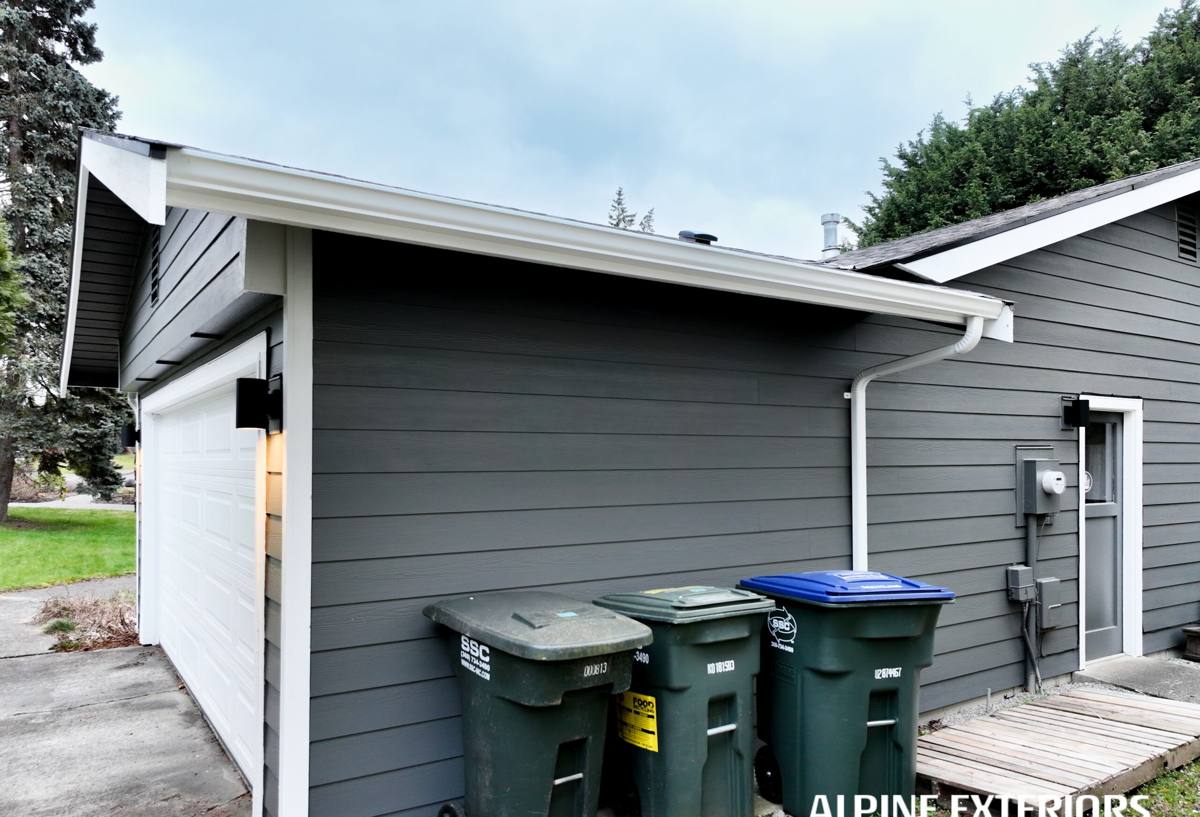
We install and repair with James Hardie fiber cement, and that's a deliberate standard rather than a default. Repair work is where mixing materials causes the most long-term trouble — different siding products expand, contract, and hold paint differently, and a patch that doesn't behave the same way as the board next to it tends to telegraph itself over a season or two, sometimes through cracking at the seam where the two materials meet. Keeping repairs in the same material family as the rest of the wall, with a factory-matched or properly field-matched finish, is what keeps a repair from looking like a repair.
If your home has siding that isn't Hardie, we can still assess it and talk through your options honestly, including whether a patch repair is worth doing on the existing material or whether it makes more sense to plan for replacement with a product that will hold up better under this area's rain and moss cycle going forward.
Why Hire a Crew That Already Works in Nooksack
Water damage on siding is rarely random — it follows the local weather pattern. A crew that's worked this stretch of Whatcom County knows which exposures tend to hold moss longest, which original installation habits from years back tend to cause callbacks now, and what a correct clearance and flashing detail actually looks like once it's opened up. That local pattern recognition is what turns a repair from a guess into a diagnosis, and it's the difference between fixing the visible damage and fixing the reason it happened.
If you're seeing moss buildup, staining, or soft spots on your siding, we're happy to take a look and give you a straight answer on whether it's a repair, how big a repair, or something bigger — with a free, no-pressure estimate and no obligation to move forward until you're ready.