 Sumas Roofing
 Ferndale's Climate Is Harder on Roofs Than It Looks
Ferndale sits close enough to the water and the marine influence of Whatcom County that homes here deal with a combination most inland roofing crews never have to plan for: salt-tinged air moving in off the coast, long stretches of driving rain that comes in sideways as much as straight down, and a moss season that can run most of the year in shaded, north-facing sections of roof. None of these on their own is unusual for Western Washington. Together, on the same roof, year after year, they add up to faster wear than a generic "Pacific Northwest roof" spec accounts for.
Salt air accelerates corrosion on exposed metal — fasteners, flashing, drip edge, valley metal — well before the shingles themselves are due for replacement. Driving rain finds every weak lap, every under-driven nail, and every place where flashing was cut short instead of properly integrated. And moss doesn't just sit on top of a roof looking bad; it holds moisture against the shingle surface, lifts tabs as it grows, and works its way under the granule layer over several seasons, which shortens the roof's real service life even if it still looks intact from the ground.
A new roof installation in Ferndale needs to be built with all three of these in mind from day one — not retrofitted later with a moss treatment or a patch job. That's the difference between a roof that makes it to 25-30 years and one that starts showing problems at year twelve.
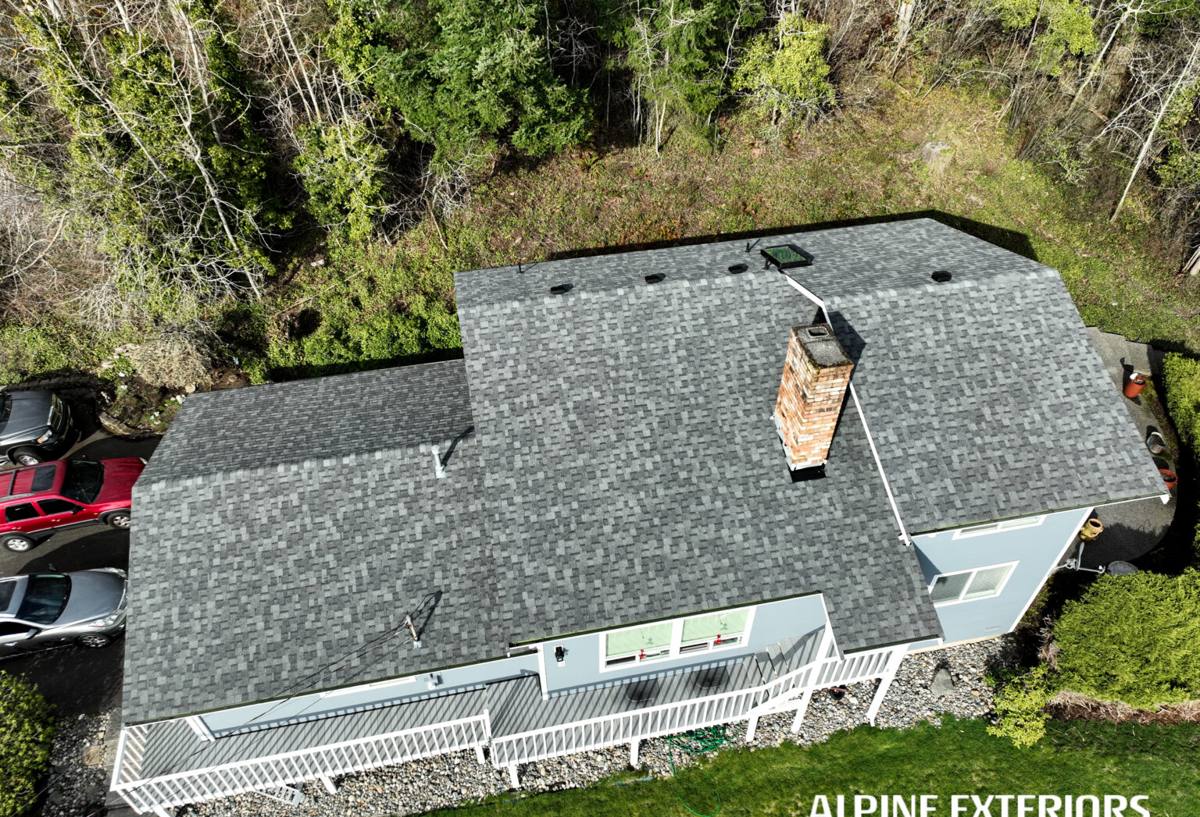
What a Correct Installation Actually Involves
"New roof" sounds like a single job, but it's really a stack of individual decisions, each of which matters more in a climate like ours than it would somewhere dry. Skipping or shortcutting any one of these is usually invisible at installation and becomes a real problem two, five, or ten years later.
Tear-Off and Deck Inspection
We remove the old roofing down to the deck rather than layering over it. That lets us actually see the plywood or OSB underneath — soft spots, old water staining, and rot don't show up until the old material is off. In a wet climate, decking that's been holding moisture under a failing roof is common enough that we plan for some deck replacement as a normal part of the job, not a surprise change order sprung on you mid-project.
Underlayment
Given how much rain Ferndale gets, we treat underlayment as a real second layer of protection, not a formality between deck and shingle. Synthetic underlayment handles wind-driven rain and stays intact through the install better than older felt products, and it matters on every roof here — not just the ones with obvious leak history.
Ice and Water Shield at Vulnerable Areas
Eaves, valleys, and roof-to-wall transitions are where driving rain and any winter freeze-thaw cycles do the most damage. Self-adhering membrane in these areas creates a sealed layer that ordinary underlayment can't match, and it's inexpensive relative to the cost of a leak repair behind drywall or insulation later.
Flashing
Flashing around chimneys, skylights, sidewalls, and valleys is where the majority of "mystery leaks" actually originate — not from worn-out shingle field. Salt air speeds up corrosion on cheap or thin flashing, so material choice and proper step-flashing technique (not just caulk and hope) matter more here than in a drier inland climate.
Ventilation
A roof that can't breathe traps moisture in the attic, which shows up as premature deck rot, mold, and shortened shingle life from the underside — separate from anything happening on top. Balanced intake and exhaust ventilation is part of every new roof we install, not an upsell.
Matching the Roofing Material to a Ferndale Home
There isn't one "best" roofing material for every house — it depends on the home's exposure, roof pitch, budget, and how much long-term maintenance the owner wants to take on. Here's how the common options compare for a coastal Whatcom County property specifically.
| Material | How It Handles Salt Air & Rain | Moss Resistance | Typical Lifespan Here |
|---|---|---|---|
| Architectural asphalt shingle | Good with quality flashing and underlayment; standard fasteners should be corrosion-resistant | Moderate — benefits from zinc/copper strips or periodic cleaning | 25-30 years |
| Standing seam metal | Excellent when using marine-grade fasteners and coatings; sheds rain fast | High — moss struggles to hold on smooth metal | 40-50+ years |
| Composite/synthetic shingle | Very good; resists moisture absorption better than organic materials | Moderate to high depending on product | 30-40 years |
| Cedar shake | Requires diligent maintenance in this moisture level | Low without regular treatment — moss and rot risk are real | Varies widely with upkeep |
For most Ferndale homes we work on, a quality architectural asphalt shingle with proper flashing and ventilation is the right balance of upfront cost and long-term performance. Standing seam metal is a strong choice for homeowners planning to stay long-term or dealing with heavy moss-prone tree cover, since it gives moss almost nothing to hold onto. We'll walk through the trade-offs for your specific roof rather than pushing one product across the board — the right call depends on your roof's exposure and how it's shaded.
Our Installation Process
- On-site assessment — we look at the existing roof, decking condition where accessible, attic ventilation, and how the roof is exposed to prevailing rain and shade patterns.
- Written estimate — material options, scope, and a clear price, with any deck-replacement contingency explained up front rather than discovered mid-job.
- Tear-off — full removal down to the deck, with daily site cleanup so your property isn't sitting exposed longer than necessary.
- Deck repair as needed — any soft or damaged sheathing is replaced before anything goes back on top of it.
- Underlayment and flashing — synthetic underlayment across the field, ice-and-water membrane at eaves/valleys/penetrations, and properly integrated flashing at every transition.
- Roofing material installation — installed to manufacturer spec and local wind/rain conditions, not the bare minimum nailing pattern.
- Ventilation check — intake and exhaust confirmed balanced for the attic space.
- Final walkthrough — we go over the finished roof with you before calling the job done.
What Drives the Cost of a New Roof
Every roof is priced individually, but the same handful of factors move the number up or down on almost every Ferndale project we quote.
| Factor | Why It Matters |
|---|---|
| Roof size and complexity | More valleys, dormers, and penetrations mean more flashing labor and material waste |
| Deck condition | Rot or soft sheathing found at tear-off adds material and labor not visible in an initial estimate |
| Material choice | Asphalt, composite, and metal have significantly different material and installation costs |
| Pitch and access | Steep roofs or difficult access (tight lots, tall trees) increase labor time and safety setup |
| Ventilation upgrades | Older homes often need added intake or exhaust vents brought up to a functioning balance |
| Layers to remove | Multiple existing layers add tear-off time and disposal cost |
We don't quote a roof without seeing it, and we won't give you a number that hides a likely deck-replacement cost until it's too late to plan for. A fair estimate accounts for what we can reasonably expect to find, given the roof's age and condition, and flags what we can't know until tear-off.
Signs a Ferndale Roof Needs Replacement, Not Another Repair
Not every roof problem means a full replacement — but in a wet, moss-prone climate, patch-repairing a roof that's genuinely at end of life usually costs more over a few years than replacing it once. Some signs worth taking seriously:
- Granules collecting in gutters or at downspout outlets in noticeable amounts
- Shingles that are curling, cupping, or losing their flat profile
- Moss buildup that returns quickly after cleaning, especially on shaded slopes
- Daylight visible through the roof deck from inside the attic
- Soft or spongy spots when walked on, or visible sagging along the roofline
- Recurring leaks in different spots each time it rains hard
- Roof age at or past 20-25 years for asphalt shingle, especially if it's never had a tear-off
- Flashing that's visibly rusted, lifted, or separating at valleys and penetrations
If you're only seeing one or two of these, a repair may still make sense. If several apply at once, a repair is often just delaying the same cost with added labor on top.
Why a Crew That Already Works Ferndale Makes a Difference
Roofing crews that mostly work drier or more sheltered areas tend to build to a generic spec — because it's what works where they usually are. A crew that works Whatcom County's coastal edge regularly already knows which flashing details fail first in driving rain, which shaded rooflines need extra attention to moss, and how corrosion-resistant fasteners and metal need to be to hold up near salt air over decades, not just pass inspection on day one.
That familiarity shows up in small decisions during installation — where to add an extra course of ice-and-water shield, how a valley gets detailed, whether a particular tree-shaded slope needs a different ventilation approach — that a generic install won't necessarily catch. Sumas Roofing Co works throughout Whatcom County, including Ferndale, and we build every roof to hold up against the specific conditions this area produces, not a national average climate.
Get an Estimate for Your Ferndale Roof
If your roof is showing its age, has recurring moss or leak problems, or you're just planning ahead, we're glad to take a look and give you an honest read on where it stands. Use the form below to request a free, no-pressure estimate, and we'll walk the roof with you and lay out your options plainly.