 Sumas Roofing
 New-Construction Windows Are a Different Job Than Replacement Windows
If you're building a new home, an addition, or a cabin in the Maple Falls area, the windows going into that project are not the same product or the same install as a "replacement window" job. New-construction windows come with a nailing fin that fastens directly to the sheathing and integrates with the weather-resistive barrier (WRB) and flashing system before siding ever goes on. Replacement windows, by contrast, are built to slide into an existing frame after the fact, with no nailing fin and a different set of trade-offs. Get a new-construction window wrong at the framing stage, and you're not looking at a quick fix later — you're looking at pulling siding and trim to correct it.
That's the job we specialize in for builders and homeowners working in and around Maple Falls: getting it right once, at the point in the build where it's actually possible to get it right.
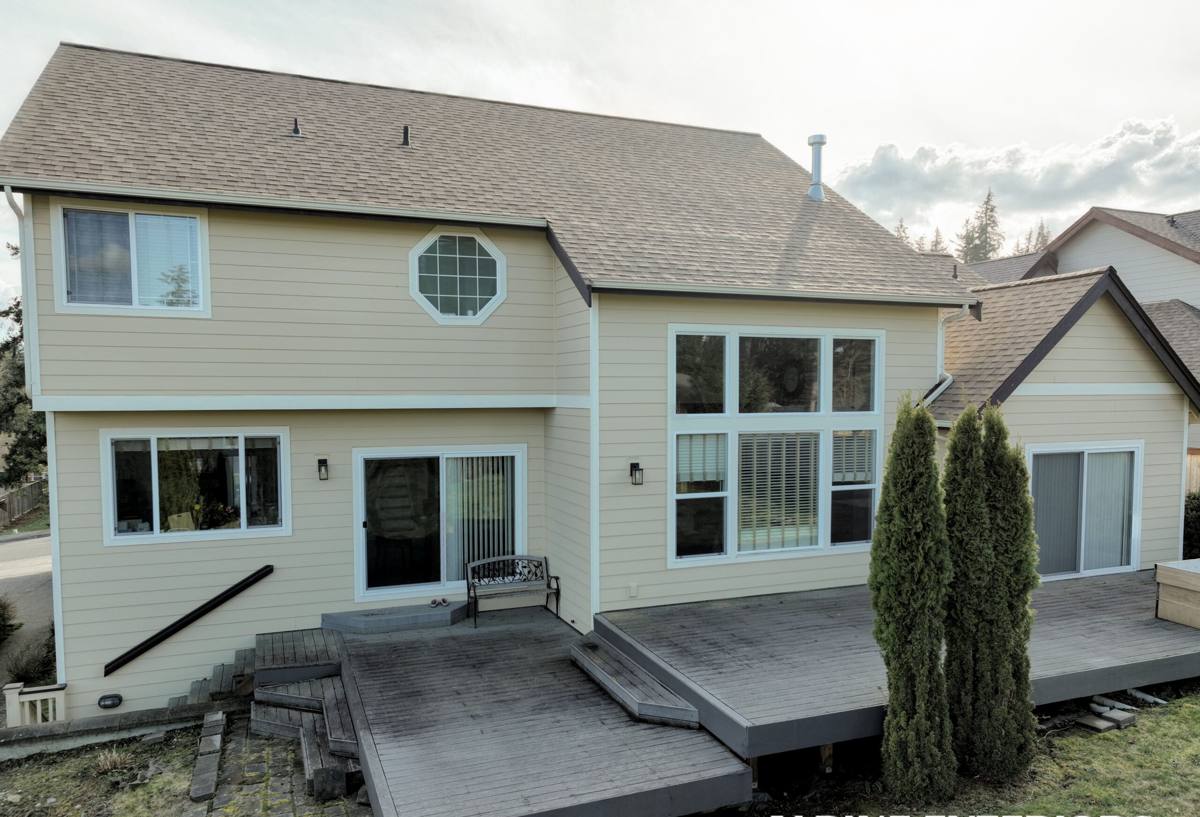
What Maple Falls' Climate Asks of a Window Install
Whatcom County's marine-influenced climate doesn't do a house any favors. Maple Falls sits up in the foothills with more tree cover and elevation than the lowlands closer to Sumas, which means more shade, slower drying after a storm, and a longer moss season on anything that stays damp. Add in the wind-driven rain that comes through the valley and the moisture-laden air that moves in off the Salish Sea, and you've got a climate that will find every weak point in a window installation eventually — usually the flashing, not the window itself.
Wind-Driven Rain and Flashing
Most window leaks aren't glass or seal failures — they're flashing failures. Wind-driven rain doesn't fall straight down; it gets pushed sideways and upward under laps that weren't sequenced correctly. In a climate like this one, a flashing detail that would hold up fine in a drier region can fail within a few seasons.
Moss, Shade, and Slow-Drying Assemblies
Shaded, tree-lined lots dry out slower after rain than open lots do. That means any water that gets behind a window opening — even a small amount — has more time to do damage before the assembly dries. Moss and organic growth on trim and sills aren't just cosmetic; they hold moisture against the wood or cladding longer than bare material would.
What a Correct New-Construction Window Installation Involves
There's a specific order of operations that makes a window opening watertight for the life of the house. Skipping steps or doing them out of sequence is how "it looked fine going in" turns into a rot problem five years later.
- WRB (house wrap) integrated into the opening before the window goes in, not patched around it afterward
- A sloped sill pan flashing at the bottom of the rough opening so any water that gets in drains back out, not into the wall
- Side flashing (jamb flashing) that laps over the sill pan and under the head flashing — proper shingle-lap order, every time
- Head flashing installed last, lapping over the WRB above the opening
- Window shimmed plumb, level, and square before fastening — not just "close enough"
- Fastening through the nailing fin per the manufacturer's schedule, not a handful of nails wherever convenient
- Gap between frame and rough opening insulated with low-expansion foam or backer rod, never packed tight enough to bow the frame
- Interior air sealing at the frame-to-framing gap, separate from the exterior weatherproofing
Frame Material Choices for This Climate
Vinyl, fiberglass, and wood or aluminum-clad wood all show up in new construction, and each behaves differently once it's living in a wet, shaded climate for years. None of them is automatically wrong — the right call depends on the house, the budget, and how much upkeep you want to sign up for.
| Frame Material | Moisture Behavior | Maintenance | Typical Cost Tier |
|---|---|---|---|
| Vinyl | Won't rot; performance depends on quality of welds and reinforcement | Low — occasional cleaning | Lower |
| Fiberglass | Very stable in wet/dry and hot/cold swings; minimal expansion or contraction | Low | Mid to upper |
| Wood/aluminum-clad wood | Attractive interior wood look, but exterior cladding seams are a maintenance-sensitive detail in a wet climate | Higher — seams and joints need periodic attention | Upper |
We don't push one product line on every job. Our standard is picking the frame material that matches how the house will actually be lived in and maintained, and being upfront about the maintenance commitment that comes with it — especially for a clad-wood product where a neglected seam can let moisture behind the cladding for years before it's noticed.
How We Handle a New-Construction Window Job in Maple Falls
- Plan review. We look at the window schedule, rough opening sizes, and elevations before anything is ordered, and flag mismatches early — cheaper to catch on paper than after a crate shows up.
- Scheduling with your builder or GC. Windows go in at a specific point in the framing sequence. We coordinate timing so the WRB is on, the opening is ready, and we're not the reason the schedule slips — or waiting on someone else's delay.
- On-site verification. We check every opening against the actual window before install, not just against the plans. Framing tolerances aren't always what the drawings say.
- Flashing and WRB integration. Sill pan, jamb flashing, window, then head flashing — in that order, lapped correctly for this climate's wind-driven rain.
- Fastening and shimming. Plumb, level, square, fastened to the manufacturer's schedule.
- Interior and exterior seal-out. Foam or backer rod at the gap, air sealing on the interior side, sill pan checked for drainage before we move to the next opening.
- Walk-through. We check operation, seals, and flashing laps on every window before we consider the opening done — not just a visual pass from the ground.
Energy Performance and Code Considerations
Washington's energy code sets minimum performance requirements for new-construction windows, and those minimums exist for a reason in a climate that runs cool and damp much of the year. U-factor (how well the window resists heat loss) matters more here than in a hot, dry climate, and condensation resistance matters more on shaded, tree-covered lots where the glass surface stays cooler longer. We spec glazing packages based on the actual orientation and shading of the opening — a window in a shaded, north-facing wall doesn't need the same solar heat gain properties as one facing open sky, and treating every opening on a house identically usually means overpaying for performance you don't need on some windows and underbuying it on others.
Mistakes We See on New-Construction Window Jobs
Most of the water damage we get called out to diagnose later traces back to a handful of repeatable errors:
- Flashing laps installed backward or out of sequence, so water runs behind the layer instead of over it
- No sill pan — just caulk and hope, with nowhere for incidental water to drain
- Caulk used as the primary water barrier instead of a backup to proper flashing
- Expanding foam packed in tight enough to bow the frame out of square, which then affects how the sash operates
- Fasteners skipped at corners or mid-span, leaving the fin unsupported where wind load is highest
- WRB cut and patched around the opening after the fact instead of integrated before
None of these show up on day one. They show up as a soft spot in trim, a musty smell, or a window that's harder to operate than it used to be, usually a couple of years in — long after the crew that installed it has moved on.
Why a Crew That Already Works Maple Falls Matters
Maple Falls isn't downtown Sumas or a subdivision lot — access can mean a steep or gravel driveway, limited staging space for materials, and weather windows that close faster once the fall rains set in at elevation. A crew that's worked the area knows what to plan for logistically before the truck ever shows up, and knows how the local building department handles inspections and scheduling on new construction. That familiarity isn't a luxury — it's the difference between a job that moves on schedule and one that stalls waiting on something that could've been anticipated.
It also means we're not learning this climate on your house. We already know what wind-driven rain does to a poorly lapped flashing detail up here, and we build the install around that from the first window, not the last.
What to Expect After Installation
A properly installed new-construction window shouldn't need much from you. Keep weep holes (if the frame has them) clear of debris, keep an eye on caulk lines at the interior trim for any separation over the first year as the house settles, and address any moss or organic buildup on exterior sills or trim before it holds moisture against the material long-term. Beyond that, the work is in the wall — which is exactly why getting it right the first time is worth the extra attention during the build.
If you're planning new construction or an addition in Maple Falls and want a straight answer on what your window openings need for this climate, we're glad to take a look. Fill out the form below for a free, no-pressure estimate.